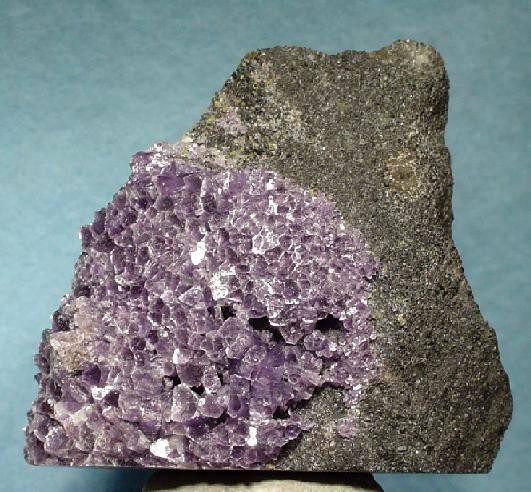
Amesite Locality: Saranovskii Mine (Saranovskoe), Saranovskaya (Sarany) Village, Gorozavodskii area, Permskaya Oblast' , Middle Urals, Urals Region, Russia ( Locality at mindat.org ) Size: 4.8 x 4.3 x 2.3 cm. Amesite is a rare kaolinite-serpentine group silicate mineral. Chrome amesite is even rarer. Chrome amesite plates, with scintillating, metallic-lavender lustre, richly covers matrix on this very showy specimen from the Saranovskii Mine of Ural. — Photo: Robert M. Lavinsky · CC BY-SA 3.0
Amesite
Amesite is a mineral with general formula of Mg2Al2SiO5(OH)4. Amesite crystallizes in the triclinic crystal system. It contains three axes of unequal length, not at right angles. It was first described in 1876 for an occurrence in the Chester Emery Mines, Chester, Hampden County, Massachusetts. It was named for mine owner James Ames. It occurs in an environment of low-grade metamorphism affecting rocks with high aluminium and magnesium content. It occurs associated with vesuvianite, chlorite, magnetite, rutile, diaspore, grossular, calcite, diopside and clinozoisite in various locations.
Intro adapted from Wikipedia (CC BY-SA).
Amesite is an IMA-recognized mineral species in the silicate class, with the chemical formula Mg₂Al(AlSiO₅)(OH)₄.
It crystallizes in the triclinic crystal system (space group C1). It is a member of the Serpentine, Clay structural group.
Key properties: Mohs hardness 2.5–3; specific gravity 2.78; White with pale green tint streak; Pearly to somewhat metallic on cleavage surfaces luster; refractive index 1.604; optically biaxial.
IMA symbol Ame, grandfathered status — known before the IMA’s founding, named in 1876.
A product of low-grade metamorphism of Al, Mg-rich rocks.
It is found associated with Vesuvianite, chlorite (Pensacola Mountains, Antarctica); magnetite, rutile, diaspore (Chester, Massachusetts, USA); grossular, calcite, diopside.
The mineral was named to honor James Ames, a mine owner.