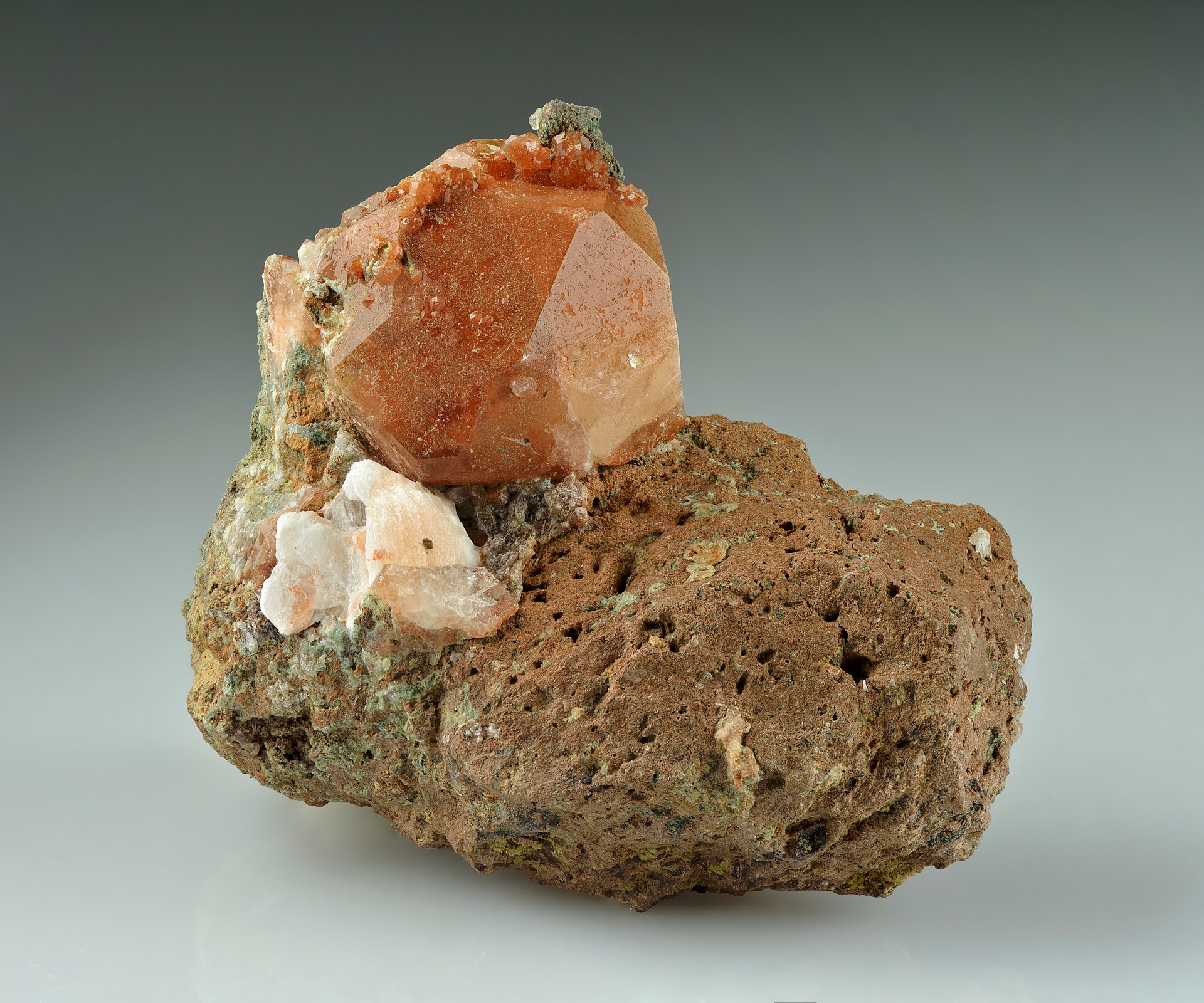
Colorless to reddish crystals of analcime up to 1.8 cm in size on matrix (4.0 × 3.0 × 2.0 cm). Found from Kahwan Mountain, Semnan, Iran — Photo: Ivar Leidus · CC BY-SA 4.0
Analcime
Also known as: Analcite.
A common white or colorless zeolite-family tectosilicate of sodium and aluminium; its name means 'not strong' in Greek, referring to its weak pyroelectricity.
Intro adapted from Wikipedia (CC BY-SA).
Analcime is an IMA-recognized mineral species in the silicate class, with the chemical formula Na(AlSi₂O₆)·H₂O.
It crystallizes in the tetragonal crystal system (space group Ia-3d). It is a member of the Analcime structural group.
Key properties: Mohs hardness 5–5.5; specific gravity 2.24–2.29; typically white or colorless or pink or green or yellow; white streak; Vitreous luster.
IMA symbol Anl, IMA status: approved, named in 1797.
Found in the groundmass or vesicles of silica-poor intermediate and mafic igneous rocks, typically basalts and phonolites, from late-stage hydrothermal solutions, or disseminated due to deuteric alteration. In lake beds.
It is found associated with Zeolites, prehnite, calcite, quartz, glauconite.
Its name comes from the Greek for weak, alluding to the weak electrostatic charge developed when heated or rubbed.
Collections: Collector Favorites.