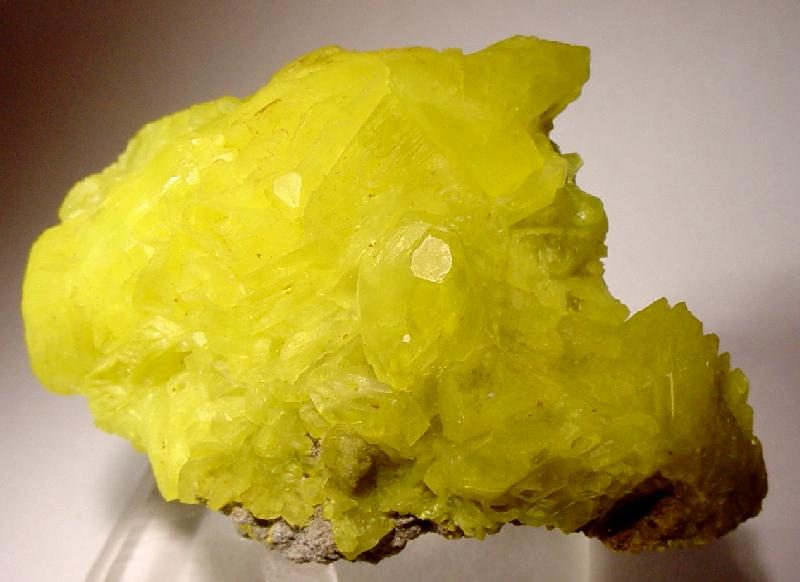
Andersonite Locality: Repete Mine, Blanding , San Juan County, Utah , USA ( Locality at mindat.org ) This is a GORGEOUS lemon-yellow miniature of a mineral we rarely see - and then as relatively boring small pieces or thumbnails. It is a solid cluster of intergrown crystals, with the most well-developed crystal rising almost 1 centimeter above the plane of more flattened, but larger crystals. This crystal has very good luster and an interesting flat hexagonal termination. Like many the other uranium minerals, the color is remarkably vivid. However, few of the vivid yellow uranium minerals produce crystals of such sheer SIZE and thus color impact, as what you see here. I believe this to be an extremely significant specimen. 5.2 x 3.6 x 1.5 cm — Photo: Robert M. Lavinsky · CC BY-SA 3.0
Andersonite
A rare hydrated sodium-calcium uranyl carbonate from sandstone-hosted uranium deposits, described in 1948 and named for USGS geologist C. A. Anderson.
Intro adapted from Wikipedia (CC BY-SA).
Andersonite is an IMA-recognized mineral species in the carbonate class, with the chemical formula Na₂Ca(UO₂)(CO₃)₃·5-6H₂O.
It crystallizes in the hexagonal crystal system (space group R-3m).
Key properties: Mohs hardness 2.5; specific gravity 2.8; refractive index 1.53; optically uniaxial.
IMA symbol Anr, grandfathered status — known before the IMA’s founding, named in 1951.
An uncommon secondary mineral, formed in the oxidized zone of uranium-bearing hydrothermal polymetallic deposits; may be post-mine, coating walls of mine tunnels.
It is found associated with Schröckingerite, bayleyite, shwartzite, boltwoodite, liebigite, gypsum.
The mineral was named to honor Charles Alfred Anderson (1902–1990), geologist with the U.S. Geological Survey, who collected the first samples.