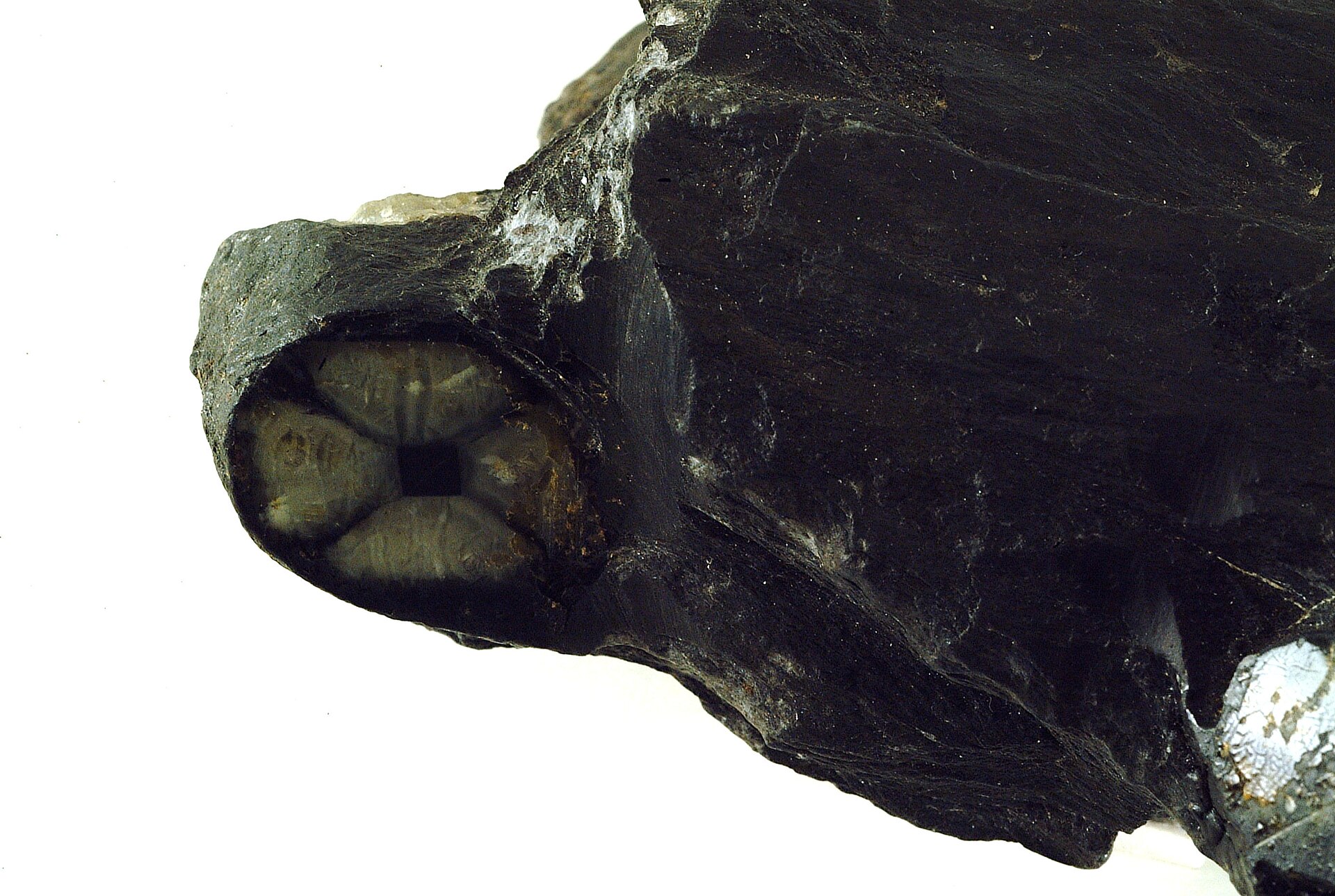
Andalusite has composition Al2SiO5, the same as kyanite and sillimanite. The varietal name “chiastolite” is used for andalusite that shows the “Maltese cross” p — Photo: Shannon Heinle · CC0
Andalusite
Also known as: Chiastolite (var.).
An aluminium silicate polymorph famous for its strong pleochroism; it was named for Andalusia — though the first specimens actually came from Guadalajara.
Intro adapted from Wikipedia (CC BY-SA).
Andalusite is an IMA-recognized mineral species in the silicate class, with the chemical formula Al₂SiO₅.
It crystallizes in the orthorhombic crystal system (space group Pnnm). It is a member of the Andalusite structural group.
Key properties: Mohs hardness 6.5–7.5; specific gravity 3.13–3.16; typically brown or pink or red or green or gray; White streak; Vitreous to subvitreous luster; refractive index 1.639; optically biaxial.
IMA symbol And, grandfathered status — known before the IMA’s founding, named in 1798.
A result of contact metamorphism of argillaceous sediments, also in regionally metamorphosed schists. Rare in granites and pegmatites, which however afford the largest crystals. Detrital in some sandstones.
It is found associated with Kyanite, sillimanite, cordierite, corundum, garnet, tourmaline, mica.
The name refers to an occurrence in the Andalusia region, Spain. All rights reserved. No part of this publication may be reproduced.
Collections: Collector Favorites, Gemstones.