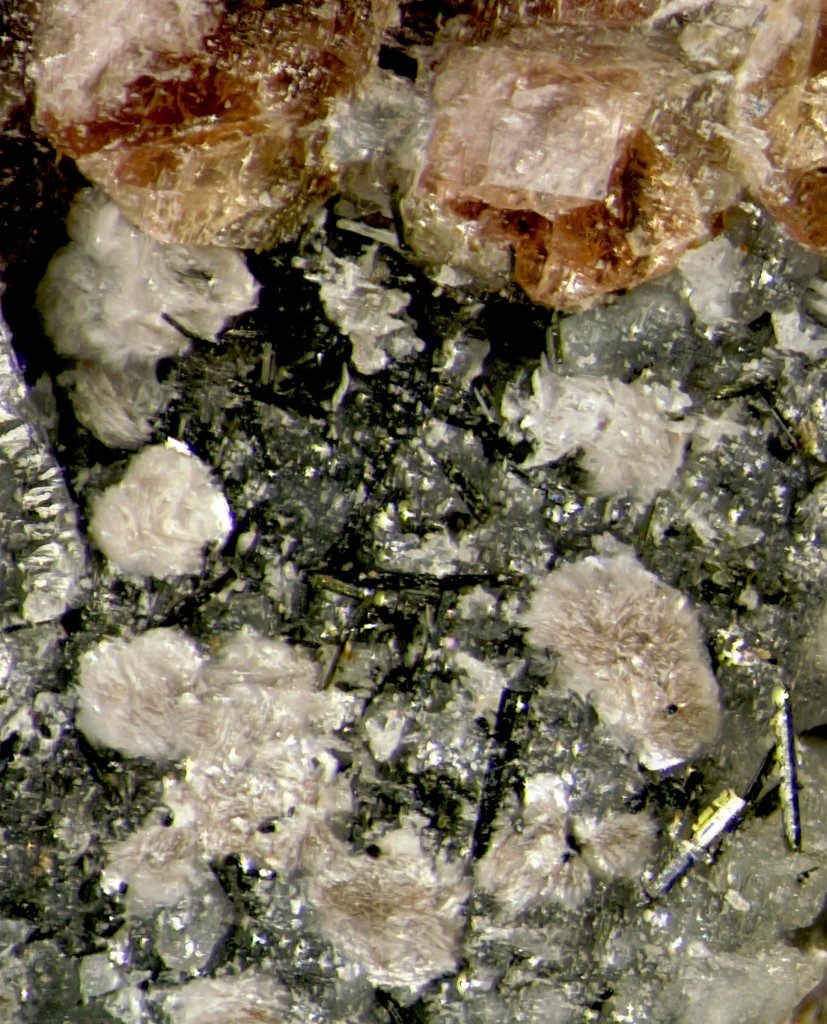
Arisite-(Ce) Locality: Poudrette quarry (Demix quarry; Uni-Mix quarry; Desourdy quarry; Carrière Mont Saint-Hilaire; MSH), Mont Saint-Hilaire, La Vallée-du-Richelieu RCM, Montérégie, Québec, Canada Description: The arisite rosettes average ~ ⅔ mm. Via Jean-Pierre Beckerich MOB coll. Tiny, pale lilac, thin foliated MSH UK 60 = IMA 2009-013 = Arisite-(Ce). For years UK60 languished in the “zombie” pile of MSH UKs that, for one reason or another, could not be submitted to IMA. However sufficiently good xls have been found at Aris (which has both -(Ce) and -(La) varieties.) Associated minerals on this specimen include small, but well formed, thich tabular nepheline and "eudialyte". The environment is probabvly sodalite xenolith. Arisite-(Ce) exhibts REE absorbtion lines. (According to Tony Steede, the pattern at MSH is reasonably distinctive.) Updated June 2013 with a new full res image with a broader view which inludes a few of the "eudialyte" xls. — Photo: Modris Baum · Public domain
Arisite-(Ce)
Arisite-(Ce) is an IMA-recognized mineral species in the carbonate class, with the chemical formula NaCe₂(CO₃)₂[F₂ₓ(CO₃)₁₋ₓ]F.
It crystallizes in the hexagonal crystal system (space group P-6m2). It is a member of the Arisite structural group.
Key properties: Mohs hardness 3–3.5; specific gravity 3.3; White streak; Vitreous luster; optically uniaxial.
IMA symbol Ari-Ce, IMA status: approved, named in 2009.
A late-stage, post-magmatic to hydrothermal mineral in miarolitic cavities in small alkaline pegmatite veins and lenticular patches within syenite and syenite sodalite xenoliths in phonolite of an alkaline intrusive complex (Mont Saint-Hila.
It is found associated with Villiaumite, aegirine, labuntsovite-group minerals, tuperssuatsiaite, natrolite, analcime, manganoneptunite, apophyllite-(KF), fluorite, makatite (Namibia).
The name refers to the Aris phonolite, Namibia, and the dominant rare earth element, Ce.