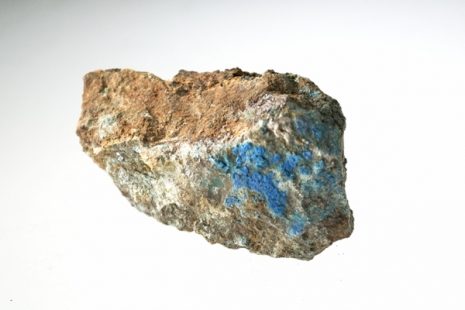
Ashburtonite Locality: Ashburton Downs Station, Ashburton Shire, Western Australia, Australia Dimensions: 4.9 cm x 2.9 cm x 2.4 cm Description: Ashburtonite is a very rare hydrated Pb-Cu silicate. Bright blue microcrystals and crusts cover part of the hefty for its size oxidized matrix. An excellent and rich example of this rare species from the Type Locality. — Photo: Robert M. Lavinsky · CC BY-SA 3.0
Ashburtonite
A rare lead-copper silicate-carbonate-chloride with an unusually complex chemistry.
Intro adapted from Wikipedia (CC BY-SA).
Ashburtonite is an IMA-recognized mineral species in the silicate class, with the chemical formula HCu₄Pb₄Si₄O₁₂(HCO₃)₄(OH)₄Cl.
It crystallizes in the tetragonal crystal system (space group I4/m). It is a member of the Cerchiaraite structural group.
Key properties: specific gravity 4.07; Light blue streak; Vitreous luster; refractive index 1.793; optically uniaxial.
IMA symbol Ahb, IMA status: approved, named in 1990.
Found in a weathered shear zone cutting shales and graywackes, as an alteration of galena and probably chalcopyrite.
It is found associated with Diaboleite, duftite, beudantite, caledonite, plattnerite, cerussite, malachite, brochantite.
The name refers to its occurrence near the Ashburton Downs pastoral lease and homestead, Western Australia.