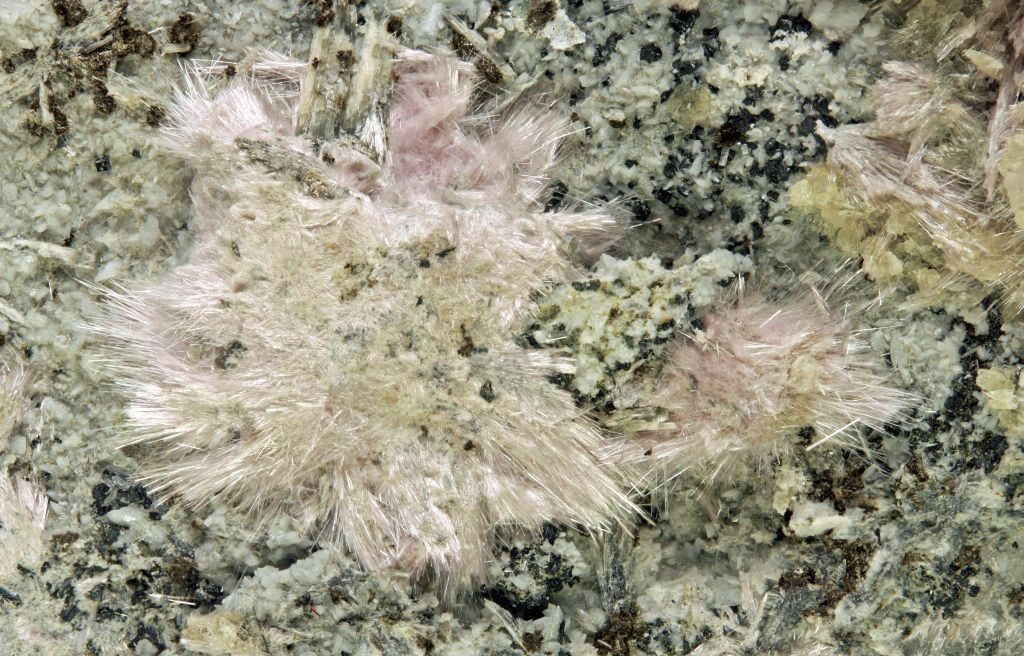
Ashcroftine-(Y) Locality: Poudrette quarry (Demix quarry; Uni-Mix quarry; Desourdy quarry; Carrière Mont Saint-Hilaire; MSH), Mont Saint-Hilaire, La Vallée-du-Richelieu RCM, Montérégie, Québec, Canada FOV ~ 2.8 cm wide Ex Jean-Pierre Beckerich. MOB coll. The color is pale lilac. A few of the xls are just big enough to show a square cross section under high magnification File:Ashcroftine-(Y)-531183.jpg . The matrix is igneous breccia. Associated minerals include terminated dark gray/green elpidite File:Elpidite, Ashcroftine-(Y), Calcite-531182.jpg yellow calcite, "ancylite" and (probably) sérandite(!) File:Serandite-531184.jpg . The sérandite has a habit very similar to that shown in [1] which is (probably) from an analyzed find. Some unid minerals are present as well. — Photo: Modris Baum · Public domain
Ashcroftine-(Y)
Ashcroftine-(Y) is a rare, hydrous, yttrium-bearing inosilicate mineral containing potassium, sodium, and calcium, together with hydroxide and carbonate anions. Its idealized chemical formula is K5Na5(Y,Ca)12Si28O70(OH)2(CO3)8 · 8H2O. It was named after the British mineral collector Frederick Noel Ashcroft (1878–1949), a benefactor of the British Museum (Natural History).
Intro adapted from Wikipedia (CC BY-SA).
Ashcroftine-(Y) is an IMA-recognized mineral species in the silicate class, with the chemical formula K₅Na₅Y₁₂Si₂₈O₇₀(OH)₂(CO₃)₈·8H₂O.
It crystallizes in the tetragonal crystal system (space group I4/mmm).
Key properties: Mohs hardness 5; specific gravity 2.61; White streak; Vitreous, may be silky luster; optically uniaxial.
IMA symbol Acf-Y, IMA status: approved, named in 1933.
Found in cavities in augite syenite (Narss^a rssuk, Greenland); in igneous breccia and pegmatites in an intrusive alkalic gabbro-syenite complex (Mont Saint-Hilaire, Canada).
It is found associated with Calcite, elpidite, albite, quartz, aegirine, orthoclase, zinnwaldite, graphite (Narss^a rssuk, Greenland); aegirine, bastnÄasite, lorenzenite, brookite.
The mineral was named to honor Frederick Noel Ashcroft (1878–1949), benefactor to the British Museum (Natural History), London, England.