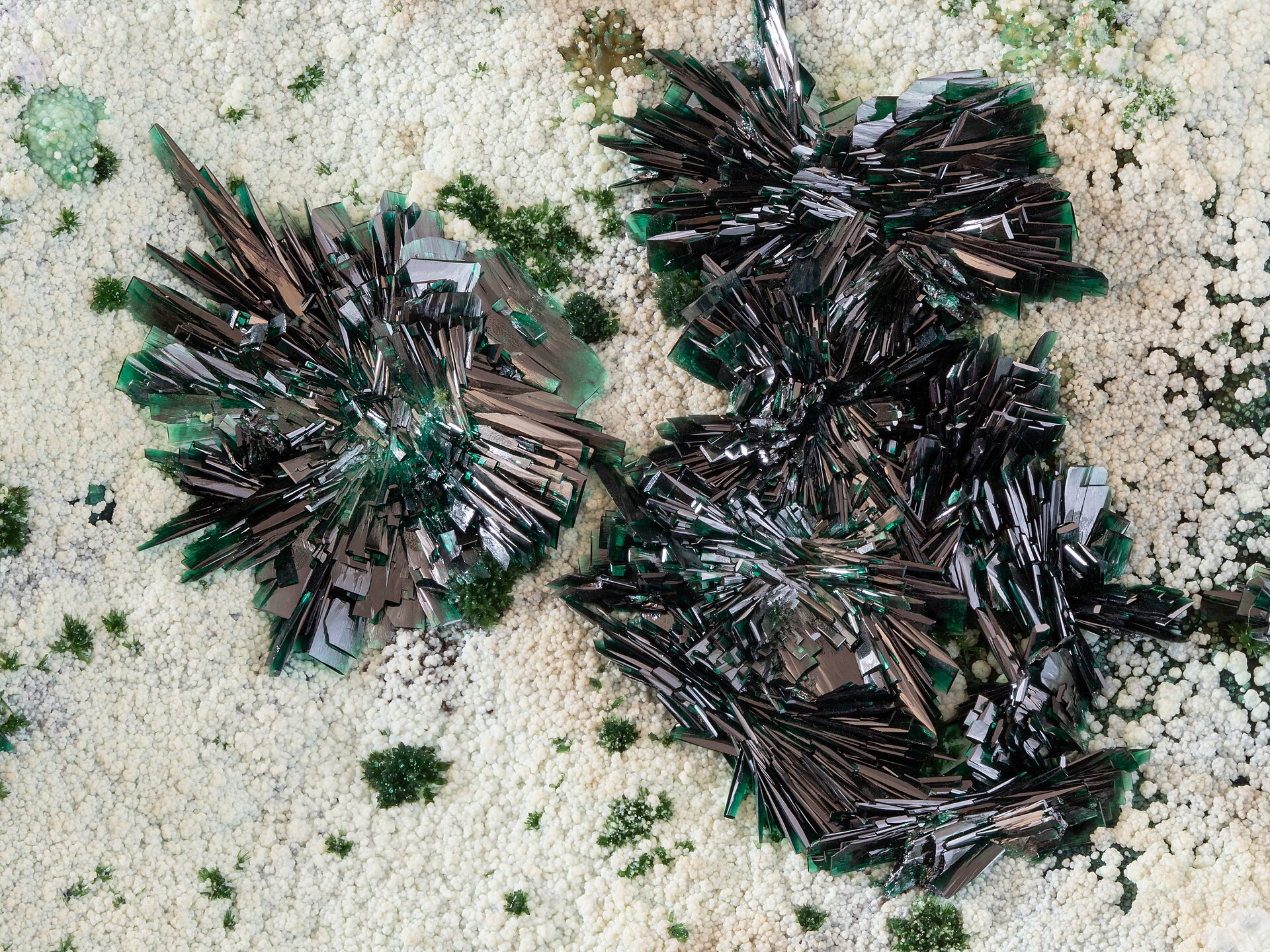
Sprays of dark green atacamite crystals on the pale halloysite from La Farola Mine, Atacama Desert, Chile. FOV: 40 mm — Photo: Zbynek Burival · CC BY-SA 4.0
Atacamite
A copper chloride hydroxide first described from Chile's Atacama Desert in 1802.
Intro adapted from Wikipedia (CC BY-SA).
Atacamite is an IMA-recognized mineral species in the halide class, with the chemical formula Cu₂Cl(OH)₃.
It crystallizes in the orthorhombic crystal system (space group Pnma). It is a member of the Atacamite structural group.
Key properties: Mohs hardness 3–3.5; specific gravity 3.75–3.78; typically green; Apple-green streak; Adamantine to vitreous luster; refractive index 1.857; optically biaxial.
IMA symbol Ata, grandfathered status — known before the IMA’s founding, named in 1803.
An oxidation product of other copper minerals, especially under arid, saline conditions; in fumarolic deposits; a weathering product of sulfides in subsea black smoker deposits; an alteration of bronze and copper objects of antiquity.
It is found associated with Cuprite, brochantite, linarite, caledonite, malachite, chrysocolla, paratacamite, botallackite.
The name refers to the undefined occurrence in the Atacama Desert, Chile.
Collections: Collector Favorites.