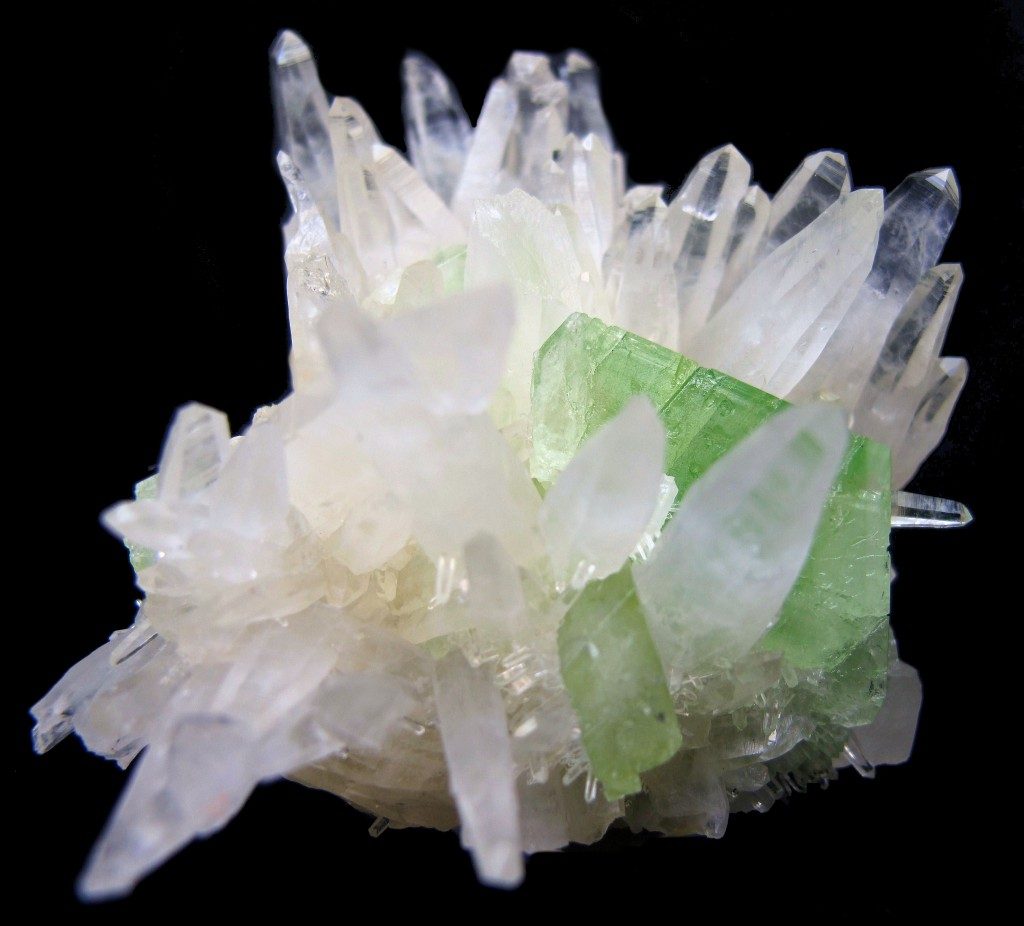
Augelite , Quartz Locality: Tamboras Mine, Mundo Nuevo, Huamachuco, Sanchez Carrion Province, La Libertad Department, Peru Original description: Group of several green augelite crystals on quartz. The largest is doubly terminated and 25 mm long. Overall size: 61 mm x 61 mm x 51 mm. Weight: 115 g. From a recent find in the Tamboras area, at 5500 m above the sea level. From "The Mineralogical Record", March-April 2011, vol. 42/2, page 141: "These specimens [augelite from Mundo Nuevo] are probably the world's finest for the species, with crystals as large as the largest known from Rapid Creek, Yukon, and from the Champion mine, California." — Photo: Carles Millan · CC BY 3.0
Augelite
A colorless-to-rose aluminium phosphate named for its pearly luster, first described from a Swedish iron mine in 1868.
Intro adapted from Wikipedia (CC BY-SA).
Augelite is an IMA-recognized mineral species in the phosphate class, with the chemical formula Al₂(PO₄)(OH)₃.
It crystallizes in the monoclinic crystal system (space group C2/m).
Key properties: Mohs hardness 4.5–5; specific gravity 2.696; White streak; Vitreous, pearly on perfect {110} cleavage luster; refractive index 1.579; optically biaxial.
IMA symbol Aul, grandfathered status — known before the IMA’s founding, named in 1868.
Formed by hydrogen metamorphism of phosphate-bearing rocks in peraluminous sediments; in some high-temperature hydrothermal ore deposits.
It is found associated with Attakolite, svanbergite, lazulite, hematite, trolleite, berlinite (Västanå mine, Sweden); lazulite, rutile, pyrophyllite, barite (Champion mine, California.
Its name comes from the Greek for luster, for its pearly luster on the cleavage.