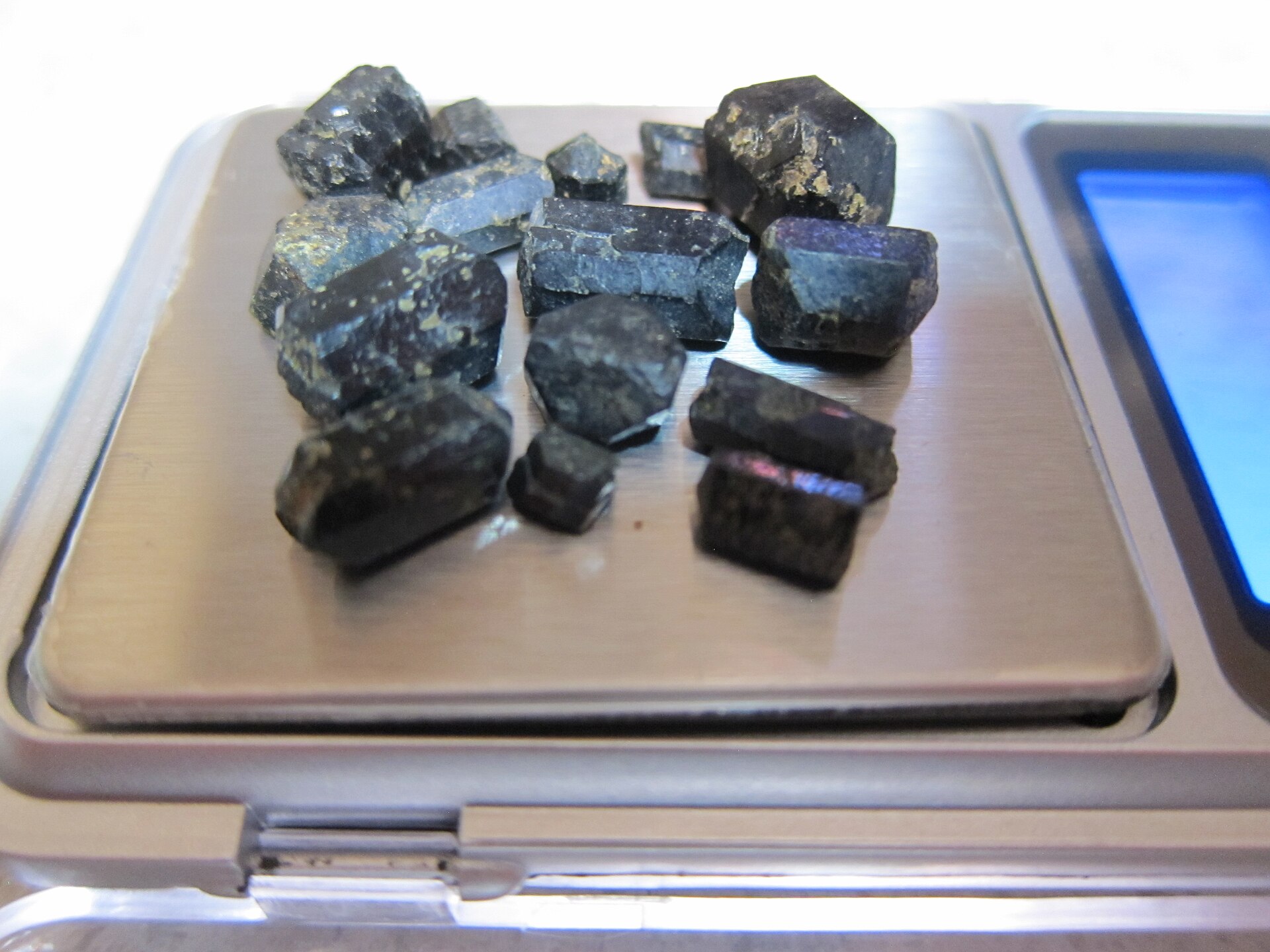
Augite crystals — Photo: Lzxlz · CC BY 4.0
Augite
Also known as: Aegirine-augite.
One of the most common rock-forming pyroxenes — a dark calcium-sodium-magnesium-iron silicate with two cleavages meeting near 90°.
Intro adapted from Wikipedia (CC BY-SA).
Augite is an IMA-recognized mineral species in the silicate class, with the chemical formula (Ca,Mg,Fe)₂Si₂O₆.
It crystallizes in the monoclinic crystal system (space group C2/c). It is a member of the Pyroxene structural group.
Key properties: Mohs hardness 5.5–6; specific gravity 3.19–3.56; typically black or brown or green; Gray-green streak; Vitreous, resinous to dull luster; refractive index 1.72; optically biaxial.
IMA symbol Aug, IMA status: approved, named in 1685.
Essential in mafic igneous rocks, basalt, gabbro; common in ultramafic rocks; in some high-grade metamorphic rocks and metamorphosed iron formations.
It is found associated with Orthoclase, sanidine, labradorite, olivine, leucite, amphiboles, pyroxenes.
Its name comes from the Greek for luster, apparently based on the appearance of its cleavage surface.
Collections: Everyday Minerals, Collector Favorites.