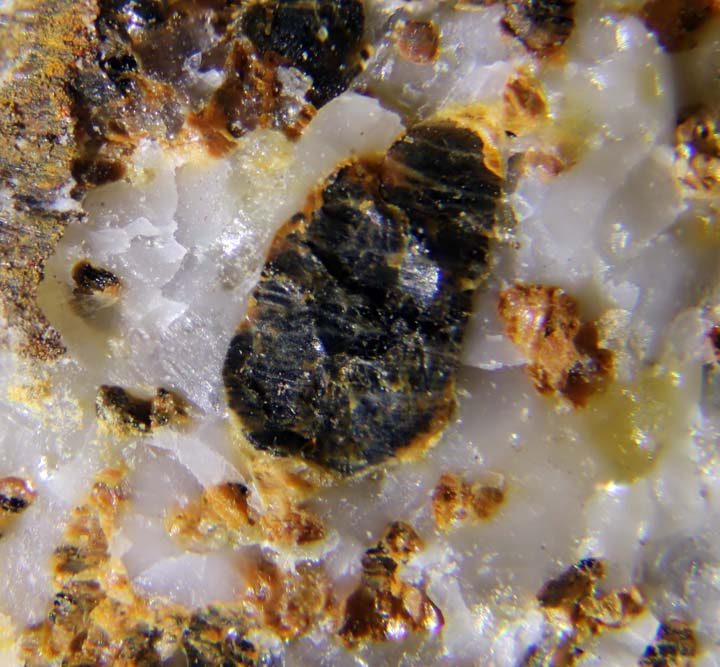
Black crystals of the rare mineral azoproite from the type and only one of the two known localities worldwide: Tazheranskii Massif, Lake Baikal, Irkutskaya Oblast', Prebaikalia, Eastern Siberia, Russian Federation. Azoproite is a magnesium borate. — Photo: David Hospital · CC BY-SA 4.0
Azoproite
Azoproite is a rare manganese iron borate mineral with the chemical formula (Mg,Fe2+)2(Fe3+,Ti,Mg)(BO3)O2. It was first identified near Lake Baikal, Russia. It was named after the Association pour l'Etude Géologique des Zones Profondes de l'Ecorce Terrestre, whose acronym is AZOPRO in French.
Intro adapted from Wikipedia (CC BY-SA).
Azoproite is an IMA-recognized mineral species in the borate class, with the chemical formula Mg₂[(Ti,Mg),Fe³⁺]O₂(BO₃).
It crystallizes in the orthorhombic crystal system (space group Pbam). It is a member of the Ludwigite structural group.
Key properties: Mohs hardness 5.5; specific gravity 3.63; Adamantine luster; optically biaxial.
IMA symbol Azo, IMA status: approved, named in 1970.
An uncommon late-stage mineral in the border zone in magnesian contact-metamorphic rocks in association with syenites; the deposit is estimated to contain 350 kT B2 O3.
It is found associated with Calcite, ludwigite, brucite, clinohumite, baddeleyite, tazheranite, perovskite, geikielite, forsterite.
A Russian acronym honoring the Study of Deep Zones of the Earth’s Crust (AZOPRO in Russian) sponsored in 1969 by the International Geological Association.