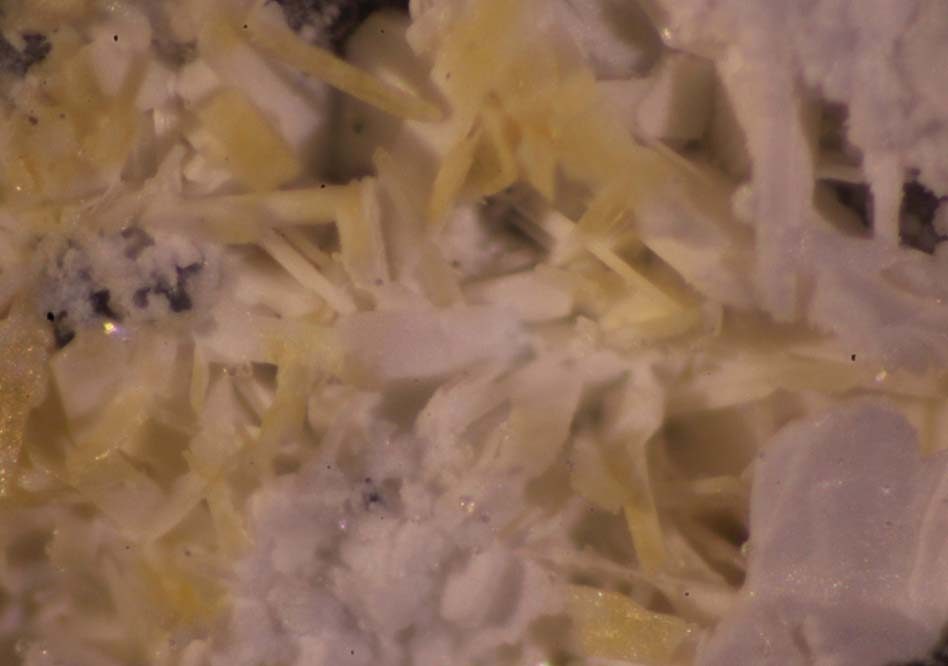
Orange platy crystals of bazhenovite, a mineral with sulphide S2-, trisulphide (S3)2- and thiosulphate (S2O3)2- anions. White associated mineral is very probably oldhamite, a calcium sulphide. Bazhenovite has only been found in five localities worldwide, so it is a very rare mineral. From: Lapanouse de Severac, Aveyron, Midi-Pyrénées, France. — Photo: David Hospital · CC BY-SA 4.0
Bazhenovite
Bazhenovite is an IMA-recognized mineral species in the sulfate class, with the chemical formula Ca₈S₅(S₂O₃)(OH)₁₂·20H₂O.
It crystallizes in the monoclinic crystal system (space group P2_1/c).
Key properties: Mohs hardness 2; specific gravity 1.83; Pale yellow streak; Vitreous, pearly on intergrowths of parallel plates luster; optically biaxial.
IMA symbol Baz, IMA status: approved, named in 1986.
Among the melt products of old, burning coal dumps.
It is found associated with Siderite, pyrite, iron, sulfur, oldhamite, portlandite, periclase, troilite, pyrrhotite, fluorite.
The name refers to Alfre Georgievich Bazhenov (1931–), geochemist and petrologist, and Lyudmila Fedorovna Bazhenova (1938–), analytical chemist, of the Il’menskii Preserve, Miass, Russia.