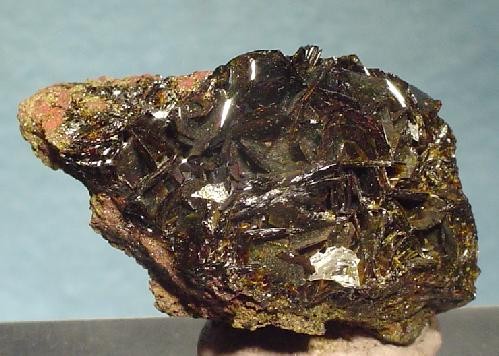
Beudantite, Tsumeb Mine, Otjikoto Region, Namibia. — Photo: Robert M. Lavinsky · CC BY-SA 3.0
Beudantite
A lead-iron arsenate-sulfate of the alunite group, formed in the oxidized zones of polymetallic deposits.
Intro adapted from Wikipedia (CC BY-SA).
Beudantite is an IMA-recognized mineral species in the arsenate class, with the chemical formula PbFe³⁺₃(AsO₄)(SO₄)(OH)₆.
It crystallizes in the hexagonal crystal system (space group R-3m). It is a member of the Alunite-beudantite structural group.
Key properties: Mohs hardness 4; specific gravity 4.48; typically brown or yellow or green or black; Grayish yellow to green streak; Vitreous, resinous, may be frosted luster; refractive index 1.95; optically uniaxial.
IMA symbol Bdn, IMA status: approved, named in 1826.
Found as a secondary mineral in the oxidized zone of polymetallic deposits.
It is found associated with Carminite, scorodite, mimetite, dussertite, arseniosiderite, pharmacosiderite, olivenite, bayldonite, duftite, anglesite, cerussite, azurite.
The mineral was named to honor François Sulpice Beudant (1787–1850), French mineralogist, University of Paris, Paris, France.
Collections: Collector Favorites.