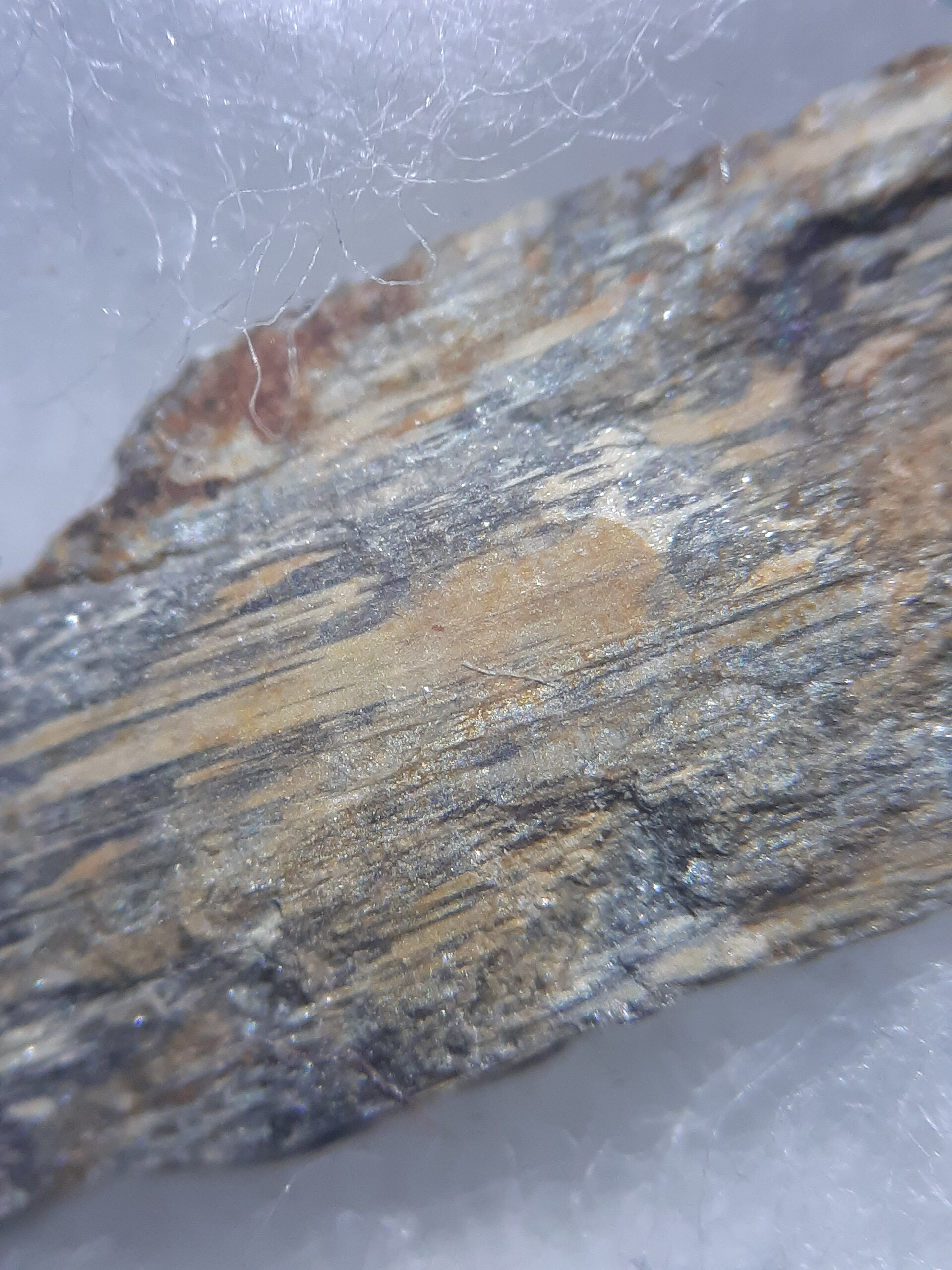
A close up of a piece of bismoclite from the Alto do Giz pegmatite in Brazil. The bismoclite is yellow and is interspersed with grey bismuthinite. The approxima — Photo: Ceasars Salad · CC BY-SA 4.0
Bismoclite
Natural bismuth oxychloride — a secondary bismuth mineral named for its two constituents.
Intro adapted from Wikipedia (CC BY-SA).
Bismoclite is an IMA-recognized mineral species in the halide class, with the chemical formula BiOCl.
It crystallizes in the tetragonal crystal system (space group P4/nmm). It is a member of the Matlockite structural group.
Key properties: Mohs hardness 2.5–3; specific gravity 7.36; typically white or gray or yellow; white streak; Greasy, silky, pearly on cleavage surfaces; dull to earthy when massive luster; optically uniaxial.
IMA symbol Bmc, grandfathered status — known before the IMA’s founding, named in 1935.
Found in an alluvial specimen, found near bismuth-bearing granite pegmatites (Jackals Water, South Africa); in greisen (Bygoo, Australia).
It is found associated with Bismutite, mica (Jackals Water, South Africa); bismuthinite (Bygoo, Australia); bismutite, jarosite, alunite, cerussite (Tintic district, Utah, USA).
In allusion to its composition, a bismuth oxychloride.
Collections: Rare & Remarkable.