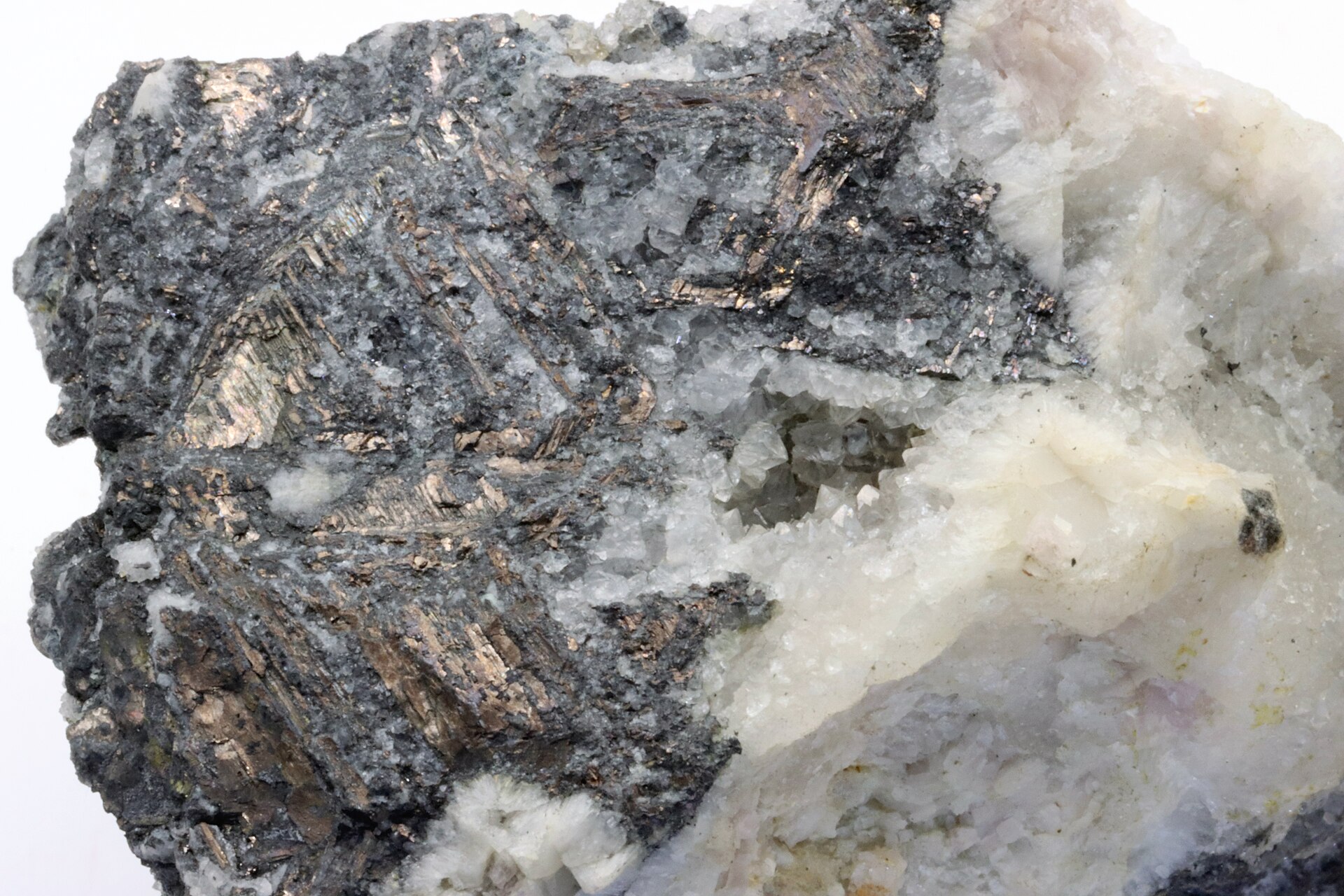
Skeletal crystals of native bismuth in quartz. La Espuela de San Miguel Mine, Villanueva de Córdoba (Córdoba), Spain. Fov 5 cm. Collection and photo Miguel Calv — Photo: Miguel Calvo · CC BY 4.0
Bismuth
Also known as: Native bismuth.
A brittle, silvery post-transition metal (symbol Bi, atomic number 83) famous for forming rainbow-hued hopper crystals when grown in the lab.
Intro adapted from Wikipedia (CC BY-SA).
Bismuth is an IMA-recognized mineral species in the native element class, with the chemical formula Bi.
It crystallizes in the trigonal crystal system (space group R-3m). It is a member of the Arsenic structural group.
Key properties: Mohs hardness 2–2.5; specific gravity 9.7–9.83; typically gray or pink; Pale silver streak; Metallic luster.
IMA symbol Bi, grandfathered status — known before the IMA’s founding, named in 1530.
Found in hydrothermal veins with ores of Co, Ni, Ag, and Sn; in pegmatites and topaz-bearing Sn–W quartz veins.
It is found associated with Chalcopyrite, arsenopyrite, pyrrhotite, pyrite, cobaltite, nickeline, breithauptite, skutterudite, safflorite, löllingite, bismuthinite, silver, cubanite.
The name comes from the German weisse masse, later wismuth, white mass.
Collections: Collector Favorites, Metals & Native Elements.