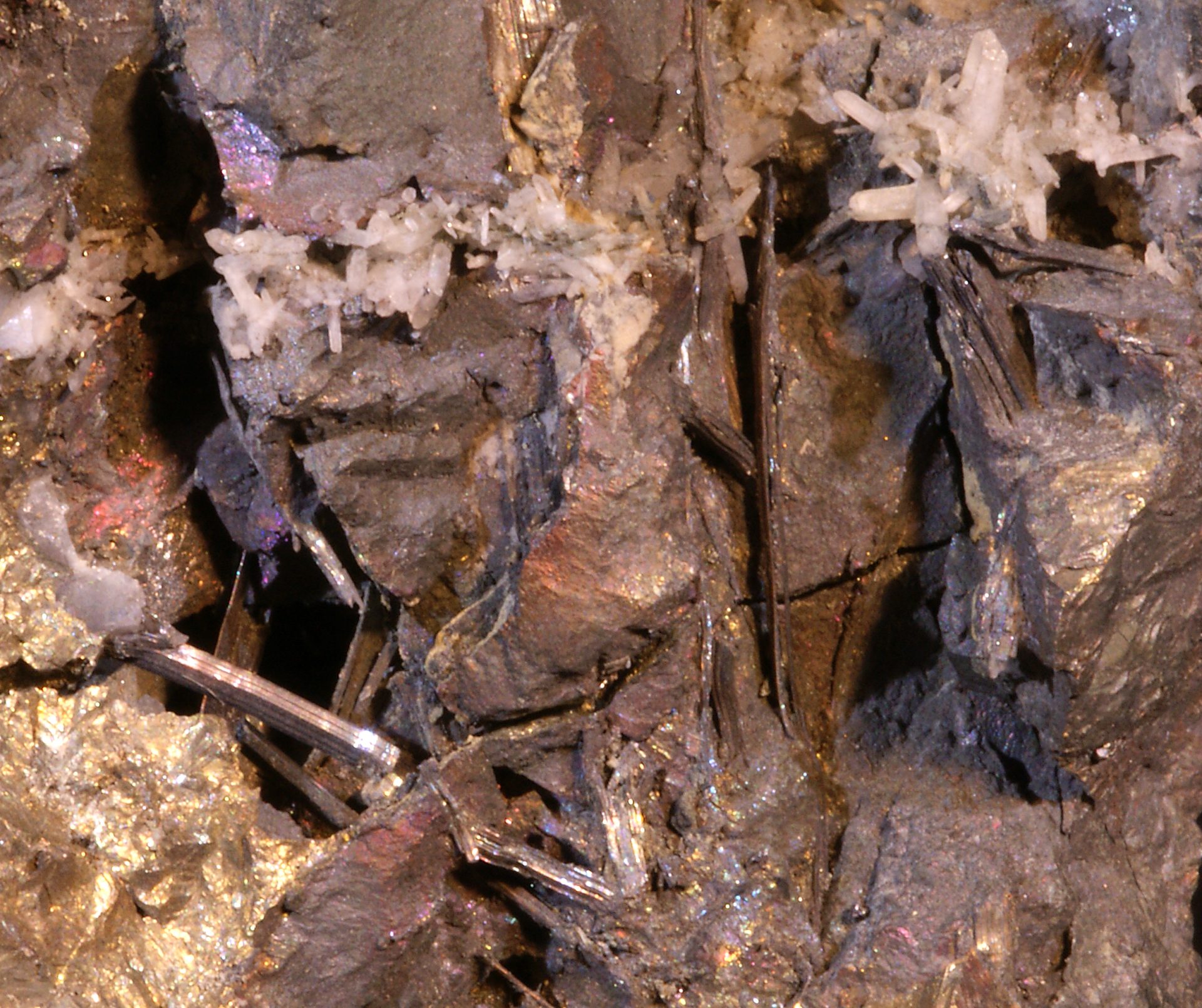
Bismuthinite - Schlaggenwald (Horni Slavkov) - Bohemia - Czech Republic (XX 1.1cm) — Photo: Didier Descouens · CC BY-SA 4.0
Bismuthinite
Bismuth sulfide — the principal ore of bismuth — steel-grey, metallic, dense, and soft enough to scratch with a fingernail.
Intro adapted from Wikipedia (CC BY-SA).
Bismuthinite is an IMA-recognized mineral species in the sulfide class, with the chemical formula Bi₂S₃.
It crystallizes in the orthorhombic crystal system (space group Pnma). It is a member of the Stibnite structural group.
Key properties: Mohs hardness 2–2.5; specific gravity 6.78; Lead-gray streak; Metallic. Anisotropism: Strong, especially in oil. R1 –R2: (400) 35.7–46.2, (420) 36.4–47.2, (440) 37.2–47.9 luster.
IMA symbol Bin, grandfathered status — known before the IMA’s founding, named in 1832.
is typically found in low- to high-temperature hydrothermal vein deposits, in tourmaline-bearing copper deposits in granite, in some gold veins formed at high temperatures, and in recent volcanic exhalation deposits.
It is found associated with Bismuth, aikinite, arsenopyrite, stannite, galena, pyrite, chalcopyrite, tourmaline, wolframite, cassiterite, quartz.
The name comes from the composition.