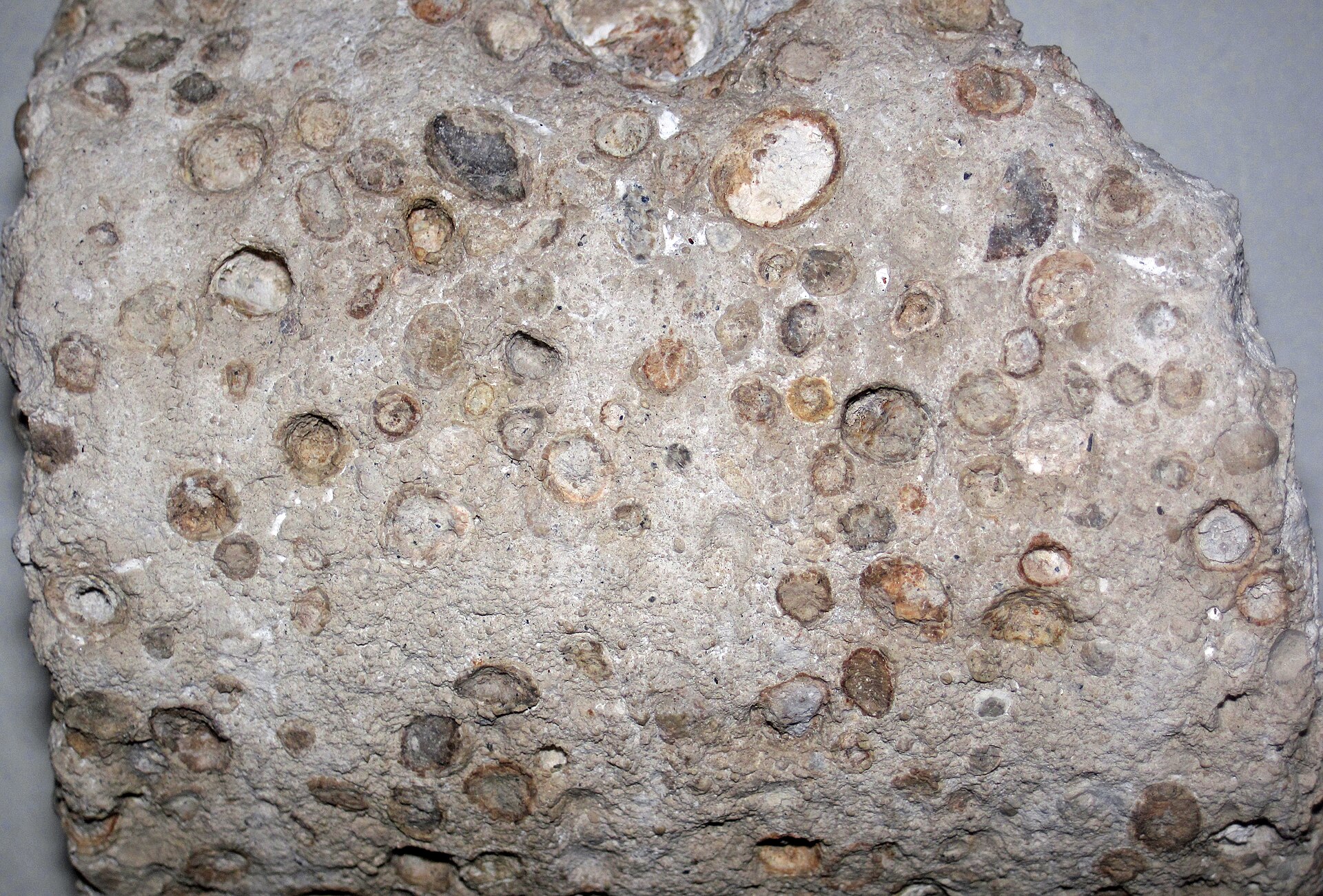
Pisolitic bauxite from Arkansas, USA. Bauxite is an aluminum oxide/hydroxide-rich rock. It is the richest source of aluminum compared with any other common roc — Photo: James St. John · CC BY 2.0
Böhmite
Aluminium oxide-hydroxide — a principal component of bauxite ore and a dimorph of diaspore.
Intro adapted from Wikipedia (CC BY-SA).
Böhmite is an IMA-recognized mineral species in the oxides & hydroxide class, with the chemical formula AlO(OH).
It crystallizes in the orthorhombic crystal system (space group Bbmm). It is a member of the Lepidocrocite structural group.
Key properties: Mohs hardness 3.5; specific gravity 3.02–3.05; typically white or gray; White streak; Vitreous, pearly on {010} luster; optically biaxial.
IMA symbol Bhm, grandfathered status — known before the IMA’s founding, named in 1927.
Formed from aluminosilicates during tropical weathering, commonly a major constituent of bauxites, laterites, or fireclays; a late product of low-temperature hydrothermal decomposition of corundum, nepheline in nepheline pegmatites.
It is found associated with Kaolinite, gibbsite, diaspore (bauxites); nepheline, gibbsite, diaspore, natrolite, analcime (nepheline pegmatites).
The name refers to Johannes Böhm (1857–1938), German geologist, who first studied the species.
Collections: Everyday Minerals.