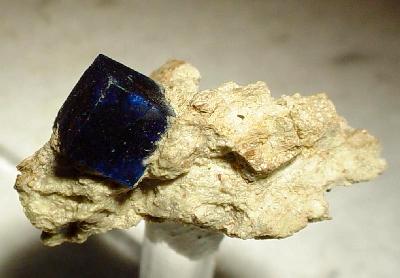
The 7mm cube, set aesthetically on matrix, is lustrous, well-formed, and the classic deep blue. — Photo: Rob Lavinsky · CC Attribution-Share Alike 3.0 Unported
Boleite
A famously complex halide that forms perfect deep-indigo cubes; first described in 1891.
Intro adapted from Wikipedia (CC BY-SA).
Boleite is an IMA-recognized mineral species in the halide class, with the chemical formula KAg₉Pb₂₆Cu₂₄Cl₆₂(OH)₄₈.
It crystallizes in the cubic crystal system (space group Pm3m).
Key properties: Mohs hardness 3–3.5; specific gravity 5.054; typically blue or purple; Blue, with greenish tint streak; Weakly vitreous; pearly on cleavage surfaces luster.
IMA symbol Bol, IMA status: approved, named in 1891.
A secondary mineral formed through reaction of chloride with primary sulfides in the oxidized zone of Pb–Cu deposits; in smelter slag immersed in and leached by sea water.
It is found associated with Pseudoboleite, cumengeite, atacamite, anglesite, cerussite, phosgenite, gypsum (Boleo, Mexico); pseudoboleite, anglesite, cerussite, atacamite, paratacamite.
The name refers to the occurrence at Boleo, Mexico.
Collections: Collector Favorites, Rare & Remarkable.