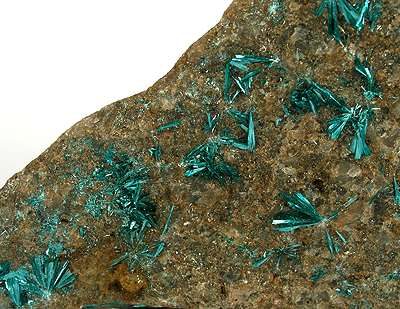
Botallackite Locality: Cligga Head, Perranzabuloe , St Agnes District, Cornwall , England , UK ( Locality at mindat.org ) Size: cabinet, 10.5 x 7.0 x 3.8 cm Botallackite A superb specimen from the recent find of late 2006 here, with sharp, metallic, unbelieveably intensely colored crystals spread over a large matrix. This is one of the best I have seen for sale from this surprising find. It is notable for the sharp separation and best metallic lustre of the individualized crystals. — Photo: Robert M. Lavinsky · CC BY-SA 3.0
Botallackite
A secondary copper oxychloride from Cornwall's Botallack mine, polymorphous with atacamite, paratacamite and clinoatacamite.
Intro adapted from Wikipedia (CC BY-SA).
Botallackite is an IMA-recognized mineral species in the halide class, with the chemical formula Cu₂Cl(OH)₃.
It crystallizes in the monoclinic crystal system (space group P2_1/m). It is a member of the Atacamite structural group.
Key properties: specific gravity 3.6; refractive index 1.807; optically biaxial.
IMA symbol Blk, grandfathered status — known before the IMA’s founding, named in 1865.
Found in copper-bearing deposits, in areas with high chlorine concentrations or weathered while exposed to seawater; a reaction product of slag immersed in seawater; a weathering product of sulfides in subsea black smoker deposits.
It is found associated with Atacamite, paratacamite (Botallack mine, Cornwall, England; Bisbee, Arizona, USA); gypsum, brochantite, connellite (Dalbeattie, Scotland).
The name refers to the occurrence in the Botallack mine, Cornwall, England.