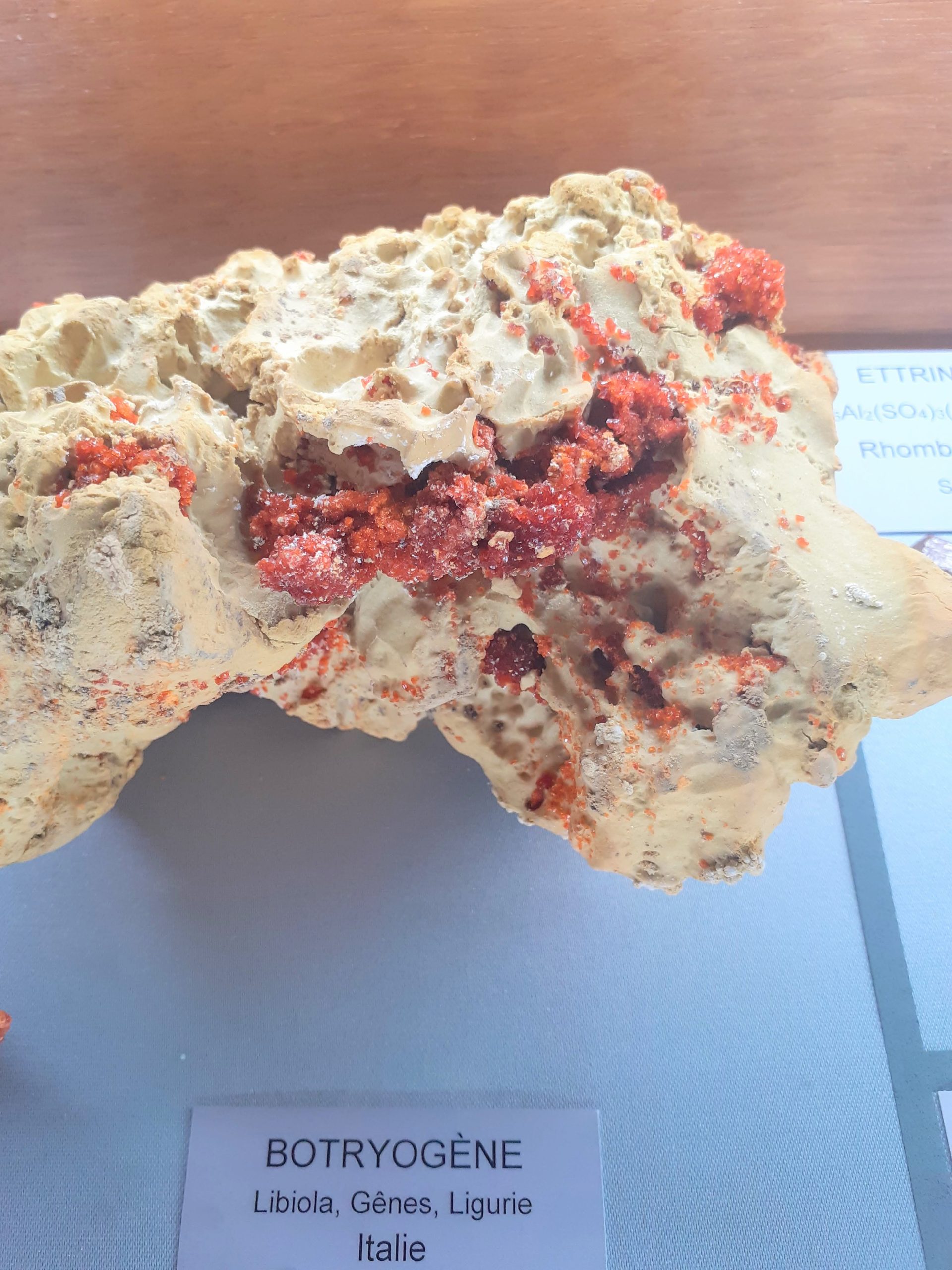
Botryogen from Libiola, Liguria, Italy in Musee de Mineralogie, Paris — Photo: Animalculum · CC BY 4.0
Botryogen
A hydrous magnesium-iron sulfate forming bright yellow-red botryoidal masses and radiating prisms.
Intro adapted from Wikipedia (CC BY-SA).
Botryogen is an IMA-recognized mineral species in the sulfate class, with the chemical formula MgFe³⁺(SO₄)₂(OH)·7H₂O.
It crystallizes in the monoclinic crystal system (space group P2_1/n). It is a member of the Botryogen structural group.
Key properties: Mohs hardness 2–2.5; specific gravity 2.14; Ocher- yellow streak; Vitreous luster; optically biaxial.
IMA symbol Byg, grandfathered status — known before the IMA’s founding, named in 1828.
A secondary mineral, which may be in great abundance, altered from pyrite, especially in arid climates.
It is found associated with Copiapite, amarantite, hohmannite, coquimbite, voltaite, pickeringite, epsomite, gypsum, chalcanthite.
Its name comes from the Greek for bunch of grapes and to bear, in allusion to the globular forms exhibited by the original material.