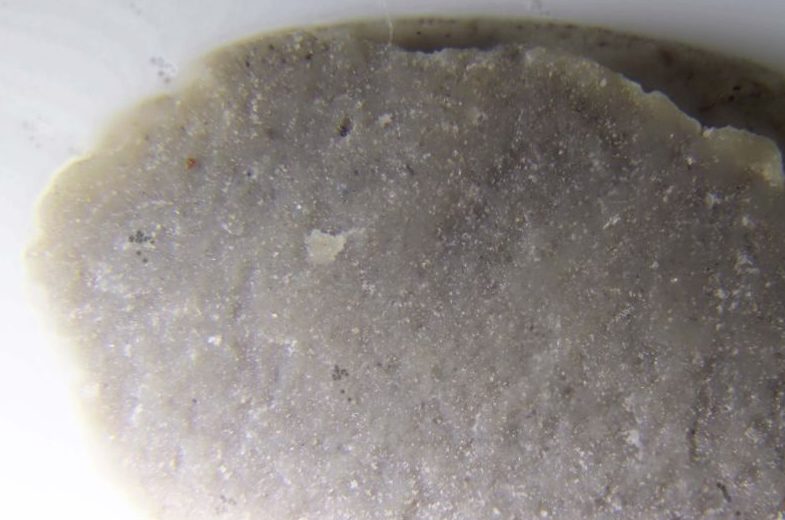
One specimen of the rare ammonium alumosilicate mineral buddingtonite from California (Sharon Heights, Menlo Park, San Mateo County, California, United States of America). Ex Vandenbroucke Museum collection from Waregem, Belgium. — Photo: David Hospital · CC BY 4.0
Buddingtonite
An ammonium feldspar formed by hydrothermal alteration — its presence can flag gold and silver mineralization.
Intro adapted from Wikipedia (CC BY-SA).
Buddingtonite is an IMA-recognized mineral species in the silicate class, with the chemical formula (NH₄)(AlSi₃)O₈.
It crystallizes in the monoclinic crystal system (space group C2/m). It is a member of the Feldspar structural group.
Key properties: Mohs hardness 5.5; specific gravity 2.32; Light grey, yellow when impure streak; Vitreous luster; refractive index 1.532; optically biaxial.
IMA symbol Bud, IMA status: approved, named in 1963.
A low-temperature hydrothermal replacement of plagioclase in andesite altered by ammonia-bearing hot springs (Sulfur Bank mine, California, USA); in metasomatized rhyolitic ash-flow tuffs (Cedar Mountains, Nevada, USA).
It is found associated with Plagioclase, sulfur, stibnite, pyrite, marcasite, ammoniojarosite, gypsum, barite, anatase, montmorillonite (Sulfur Bank mine, California, USA); illite.
The mineral was named to honor Emeritus Professor Arthur Francis Buddington (1890–1980), American geologist, Princeton University, Princeton, New Jersey, USA.