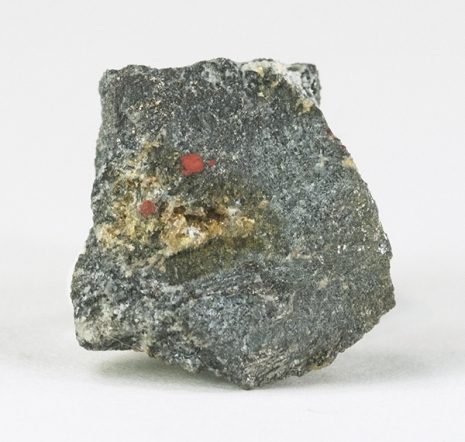
From: Bukov Mine, Rožná deposit, Žďár nad Sázavou, Vysočina Region, Moravia (Mähren; Maehren), Czech Republic Bukovite is a rare Tl-Cu-Fe selenide and this abandoned uranium mine is the Type Locality. Metallic grayish-brown grains are noted by the two red dots. Seldom available. Ex. Josef Vajdak Collection, a noted Czech specialist. Dimensions: 1.4 cm x 1.4 cm x 0.8 cm — Photo: Robert M. Lavinsky · CC BY-SA 3.0
Bukovite
A rare brown-to-black thallium-copper-iron selenide described in 1971 from the Bukov uranium mine in Moravia.
Intro adapted from Wikipedia (CC BY-SA).
Bukovite is an IMA-recognized mineral species in the sulfide class, with the chemical formula Cu₄Tl₂Se₄.
It crystallizes in the tetragonal crystal system (space group I4/mmm). It is a member of the Bukovite structural group.
Key properties: Mohs hardness 2; specific gravity 7.4; Metallic luster.
IMA symbol Bko, IMA status: approved, named in 1970.
Found in selenium-bearing veins of hydrothermal origin.
It is found associated with Clausthalite, eskebornite, eucairite, chaméanite, umangite, berzelianite, hakite, klockmannite, sabatierite, crookesite, ferroselite, cadmoselite, pyrite.
The name refers to its occurrence at Bukov, Czech Republic.