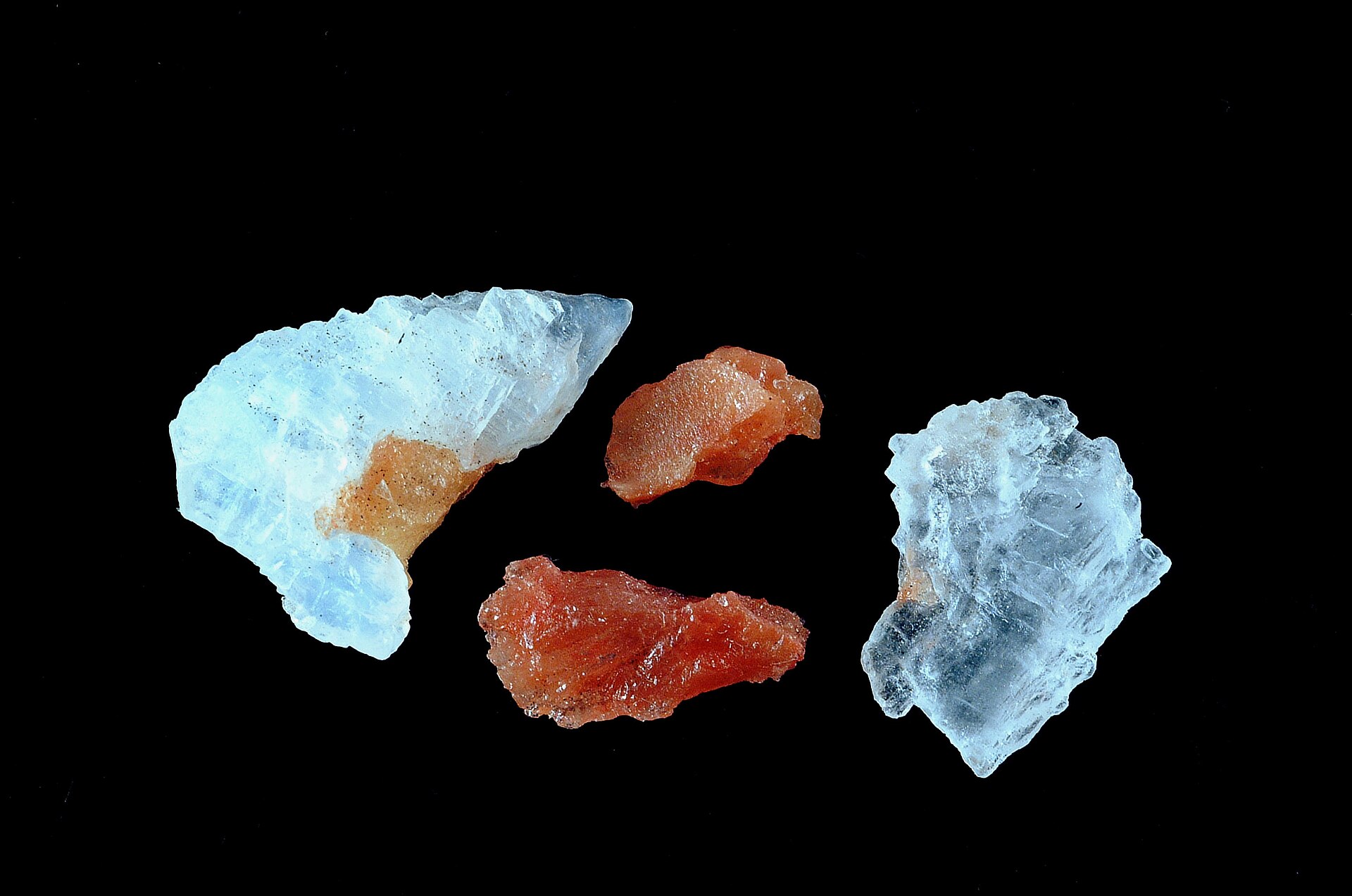
Carnallite from Estherhazy, Saskatchewan, ranges in colors from clear-translucent to yellow to red-brown. Carnallite is a hydrated potassium magnesium chloride, — Photo: Shannon Heinle · CC0
Carnallite
A hydrated potassium-magnesium chloride evaporite — the chief ore of potash in many deposits, ranging from colorless to yellow, red or blue.
Intro adapted from Wikipedia (CC BY-SA).
Carnallite is an IMA-recognized mineral species in the halide class, with the chemical formula KMgCl₃·6H₂O.
It crystallizes in the orthorhombic crystal system (space group Pnna). It is a member of the Carnallite structural group.
Key properties: Mohs hardness 2.5; specific gravity 1.6; typically colorless or white or yellow or red or pink; white streak; Greasy, shining luster; refractive index 1.479; optically biaxial.
IMA symbol Cna, grandfathered status — known before the IMA’s founding, named in 1856.
Thought to form in saline marine deposits by reaction of pre-existing saline minerals with fluids high in potash.
It is found associated with Kieserite, sylvite, halite, polyhalite, bischofite.
The name refers to Rudolph von Carnall (1804-1874), Prussian mining engineer.
Collections: Everyday Minerals.