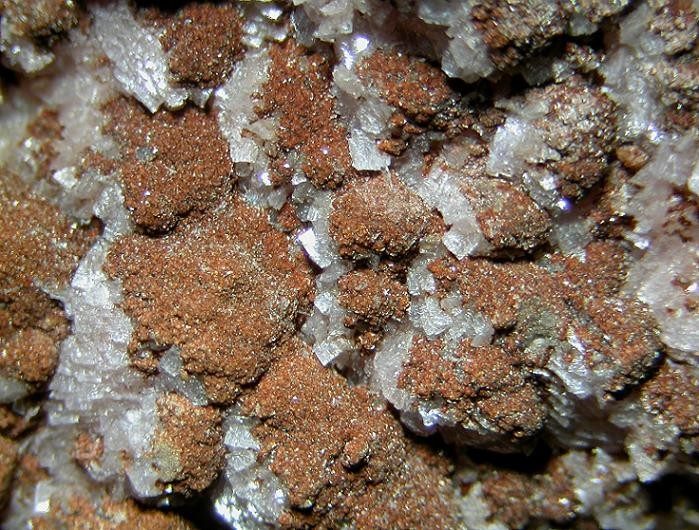
Caryopilite , Rhodochrosite Locality: N'Chwaning II Mine, N'Chwaning Mines, Kuruman , Kalahari manganese fields, Northern Cape Province , South Africa ( Locality at mindat.org ) Brown crust of Caryopilite on Rhodochrosite. Field of view 15 mm. Specimen and photo Leon Hupperichs. — Photo: Leon Hupperichs · CC BY-SA 3.0
Caryopilite
A brown manganese silicate named from the Greek for 'walnut felt' after its appearance; discovered in Sweden in 1889.
Intro adapted from Wikipedia (CC BY-SA).
Caryopilite is an IMA-recognized mineral species in the silicate class, with the chemical formula Mn²⁺₃Si₂O₅(OH)₄.
It crystallizes in the monoclinic crystal system. It is a member of the Serpentine, Clay structural group.
Key properties: Mohs hardness 3–3.5; specific gravity 2.83–2.94; optically biaxial.
IMA symbol Cpl, IMA status: approved, named in 1889.
A product of the metamorphism of manganese-bearing minerals.
It is found associated with Gonyerite (Lºangban, Sweden); calcite, rhodonite, lead, sarkinite, brandtite (Pajsberg, Sweden); manganoan calcite, tirodite, rhodonite, jacobsite (Bald Knob.
Its name comes from the Greek for walnut and felt, in allusion to its color and habit.