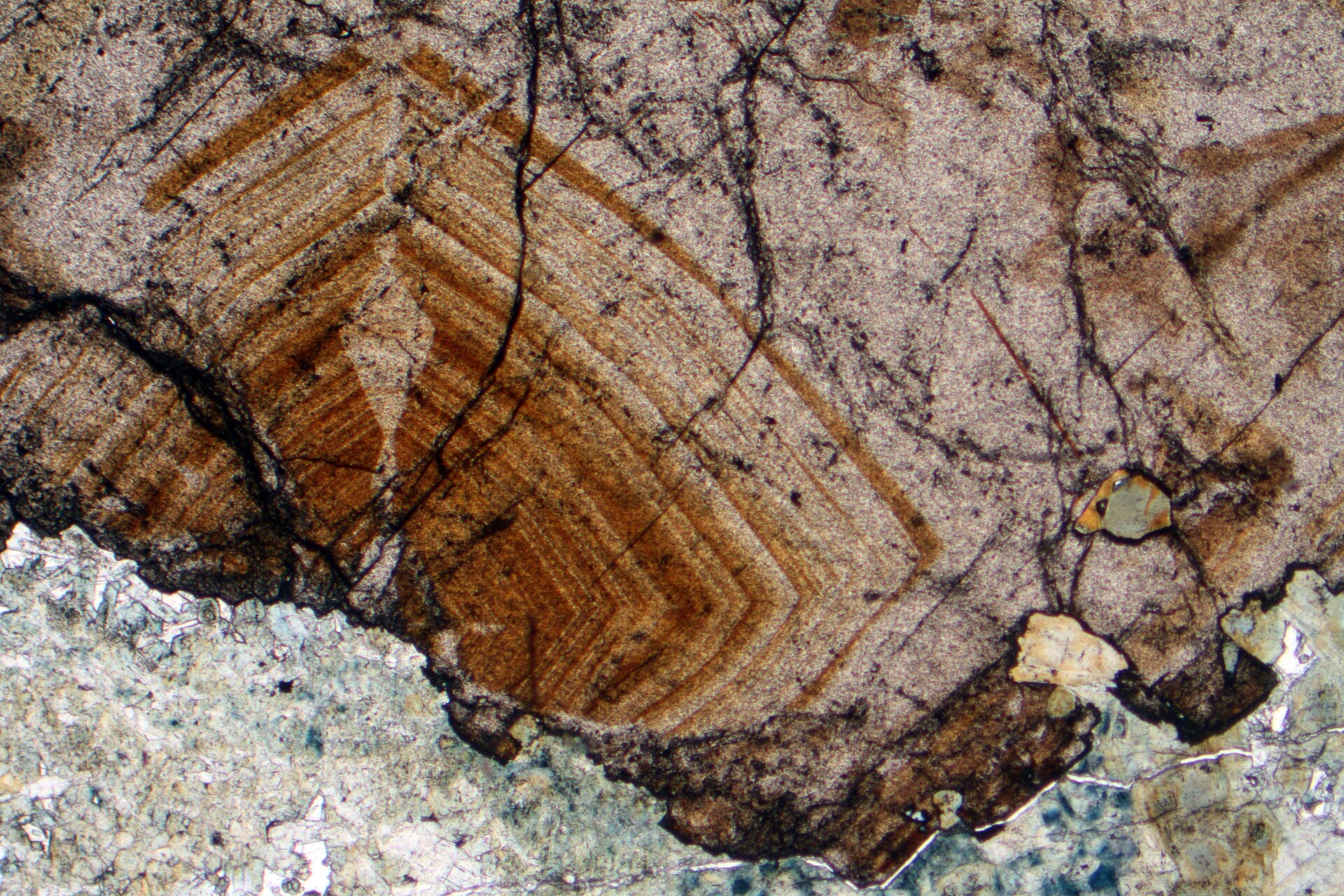
Zoned cassiterite crystals (brown) from Goonbarrow china clay pit, Cornwall — Photo: Strekeisen · CC BY 4.0
Cassiterite
Also known as: Tin ore, Tinstone.
Tin oxide — the overwhelmingly dominant ore of tin since ancient times, and a dense, high-luster mineral occasionally cut as a gem.
Intro adapted from Wikipedia (CC BY-SA).
Cassiterite is an IMA-recognized mineral species in the oxides & hydroxide class, with the chemical formula SnO₂.
It crystallizes in the tetragonal crystal system (space group P4_2/mnm). It is a member of the Rutile structural group.
Key properties: Mohs hardness 6–7; specific gravity 6.98–7.01; typically brown or black or yellow or red; White, pale brown, pale gray streak; Adamantine to adamantine metallic, splendent; may be greasy on fractures luster; refractive index 2.049; optically uniaxial.
IMA symbol Cst, grandfathered status — known before the IMA’s founding, named in 1832.
Found in medium- to high-temperature hydrothermal veins and greisen, in granite, granite pegmatite, rhyolite; rarely in contact metamorphic deposits; in large alluvial placers.
It is found associated with Quartz, muscovite, wolframite, tourmaline, topaz, fluorite, scheelite, lepidolite, arsenopyrite, bismuth, molybdenite.
Its name comes from the Greek for tin.
Collections: Metals & Native Elements, Collector Favorites.