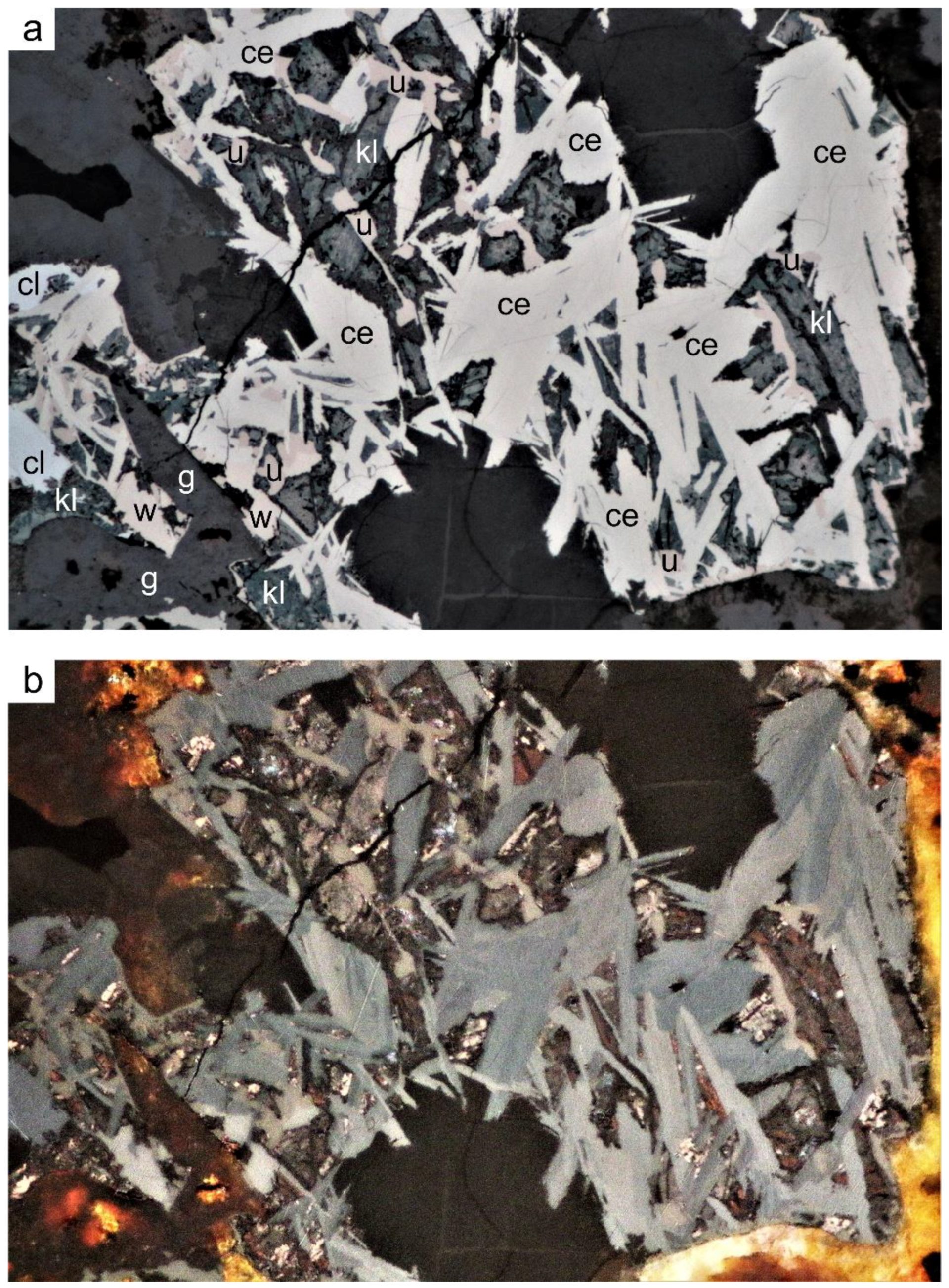
Type-II cerromojonite associated with klockmannite, unnamed CuNi2Se4, clausthalite, and later-formed goethite in reflected light: (a) 1 polarizer, (b) partially crossed polarizers. Horizontal field of view is 200 µm. Abbreviations: ce = cerromojonite, kl = klockmannite, w = watkinsonite, cl = clausthalite, u = unnamed CuNi2Se4, g = goethite. From the article "Cerromojonite, CuPbBiSe3, from El Dragόn (Bolivia): A New Member of the Bournonite Group" distributed under the terms and conditions of the Creative Commons Attribution (CC BY) license ( https://creativecommons.org/licenses/by/4.0/ ). — Photo: Förster, H.-J.; Bindi, L.; Grundmann, G.; Stanley, C.J. · CC BY 4.0
Cerromojonite
Cerromojonite is an IMA-recognized mineral species in the sulfosalt class, with the chemical formula CuPbBiSe₃.
It crystallizes in the orthorhombic crystal system (space group Pn2_1m). It is a member of the Bournonite structural group.
Key properties: specific gravity 7.035; Black, gray to cream-white in reflected light streak; Metallic luster.
IMA symbol Cmj, IMA status: approved, named in 2018.
Found in a vein in a shear zone cutting a series of thinly stratified, pyrite-rich black shales, and reddish-gray, hematite-bearing siltstones.
It is found associated with Type I: hansblockite, quijarroite, penroseite, klockmannite, watkinsonite, clausthalite, petrovicite; Type II: watkinsonite, quijarroite, clausthalite.
The name refers to Cerro Mojon, the highest mountain peak near where the first specimens were collected.