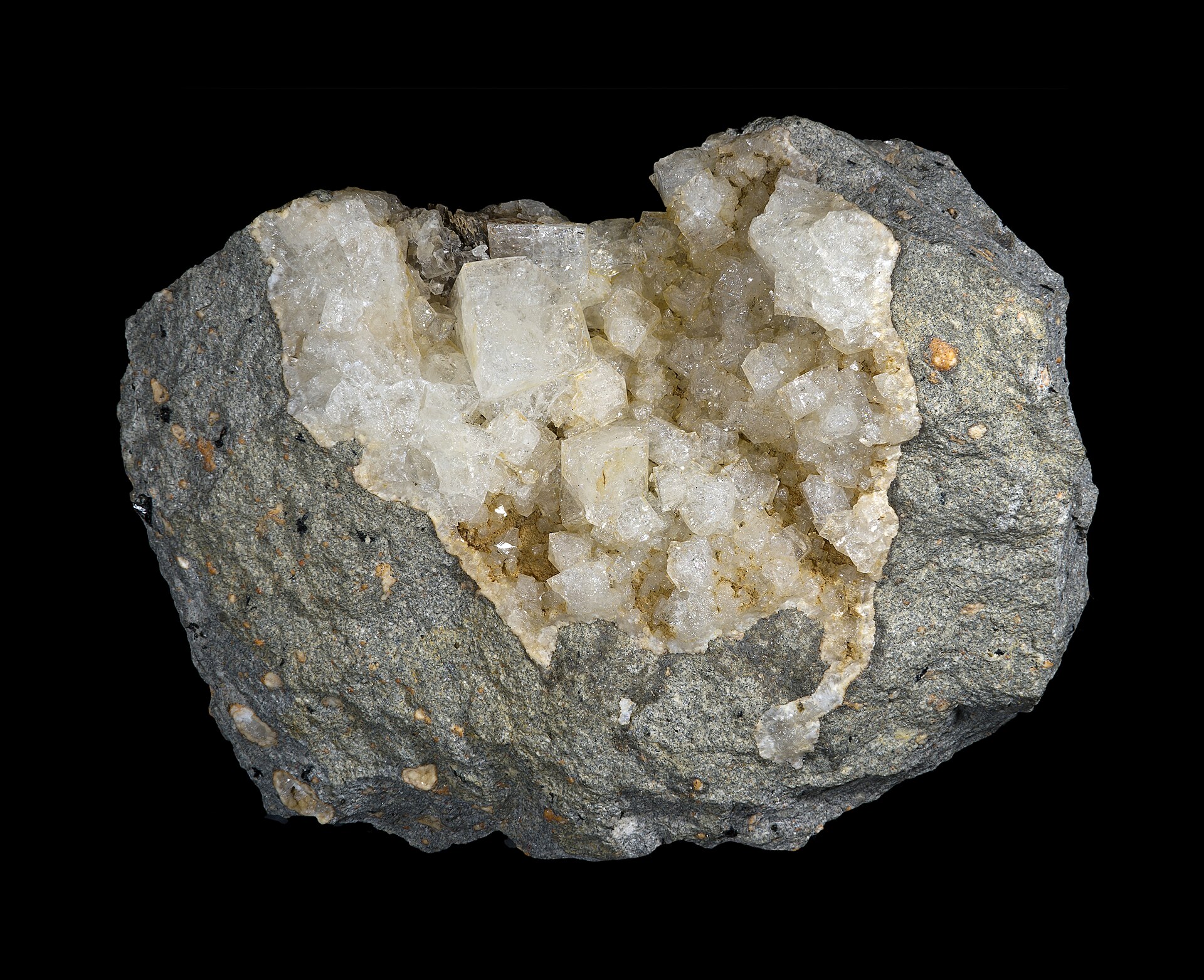
Chabazite-Ca Locality : Řepčice (Rübendörfl), Třebušín, Ústí Region, Bohemia, Czech Republic Size : 72x54x30 mm — Photo: Didier Descouens · CC BY-SA 3.0
Chabazite-Ca
Also known as: Chabazite.
Chabazite (UK: ) is a tectosilicate mineral series in the zeolite group, closely related to gmelinite, with the chemical formula M[Al2Si4O12]·6H2O, where M is one or more metal cations. Recognized minerals in the series include Chabazite-Ca, Chabazite-K, Chabazite-Na, and Chabazite-Sr, depending on the prominence of the indicated cation. Chabazite crystallizes in the triclinic crystal system with typically rhombohedral shaped crystals that are pseudo-cubic. The crystals are typically twinned, and both contact twinning and penetration twinning may be observed.
Intro adapted from Wikipedia (CC BY-SA).
Chabazite-Ca is an IMA-recognized mineral species in the silicate class, with the chemical formula Ca₂[Al₄Si₈O₂₄]·13H₂O.
It crystallizes in the trigonal crystal system (space group R-3). It is a member of the Chabazite structural group.
Key properties: Mohs hardness 4–5; specific gravity 2.05–2.2; typically white or pink or orange or colorless or yellow or brown; White streak; Vitreous luster; optically biaxial.
IMA symbol Cbz-Ca, IMA status: approved, named in 1792.
Found in volcanic rocks as basalts, andesite; rarer in limestones and schists; hydrothermally deposited in cavities and joints in ore veins. In tuff in lake deposits, altered from volcanic glass.
It is found associated with Zeolites, nepheline, melilite, olivine, pyroxenes, amphiboles, axinite, epidote, calcite, tridymite, dolomite.
Its name comes from the Greek chabazios, an ancient name of a stone. A suffix indicates the most abundant extra-framework cation.
Collections: Collector Favorites.