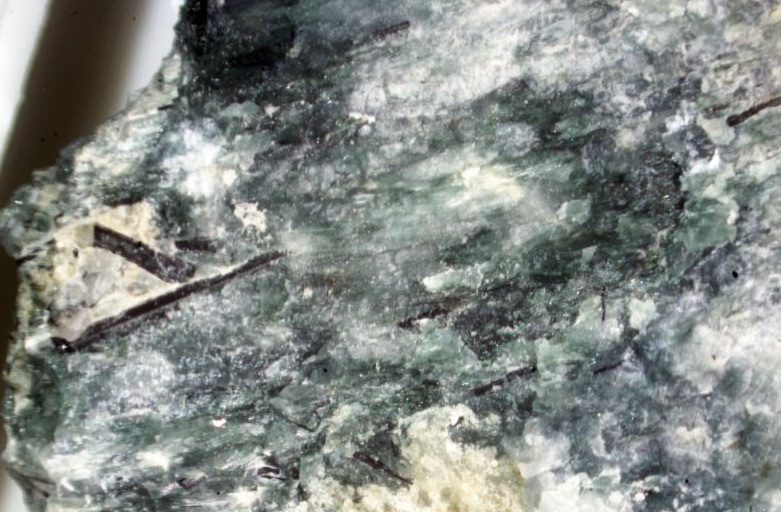
Grey green crystal aggregates of the rare Mg-Fe mineral chestermanite from the type and only locality worldwide in California (Potter Pass, Lakeshore, Fresno County, California, United States of America). Ex Vandenbroucke Museum collection from Waregem, Belgium. — Photo: David Hospital · CC BY-SA 4.0
Chestermanite
Chestermanite is an IMA-recognized mineral species in the borate class, with the chemical formula Mg₂(Fe³⁺,Mg,Al,Sb⁵⁺)O₂(BO₃).
It crystallizes in the orthorhombic crystal system (space group Pbam).
Key properties: Mohs hardness 6; specific gravity 3.72; Pale grayish green streak; Vitreous to silky luster; optically biaxial.
IMA symbol Csm, IMA status: approved, named in 1986.
Rare, in veins and disseminated in a brucite marble lens contained in a multiply metamorphosed roof pendant between two plutons in a granodiorite batholith.
It is found associated with Magnesian–aluminian ludwigite, magnesian calcite, fluoborite, wightmanite, spinel, brucite, safflorite, löllingite.
The mineral was named to honor Charles Wesley Chesterman (1913–1991), geologist and mineralogist, California Division of Mines and Geology, San Francisco, USA, who discovered the first specimens.