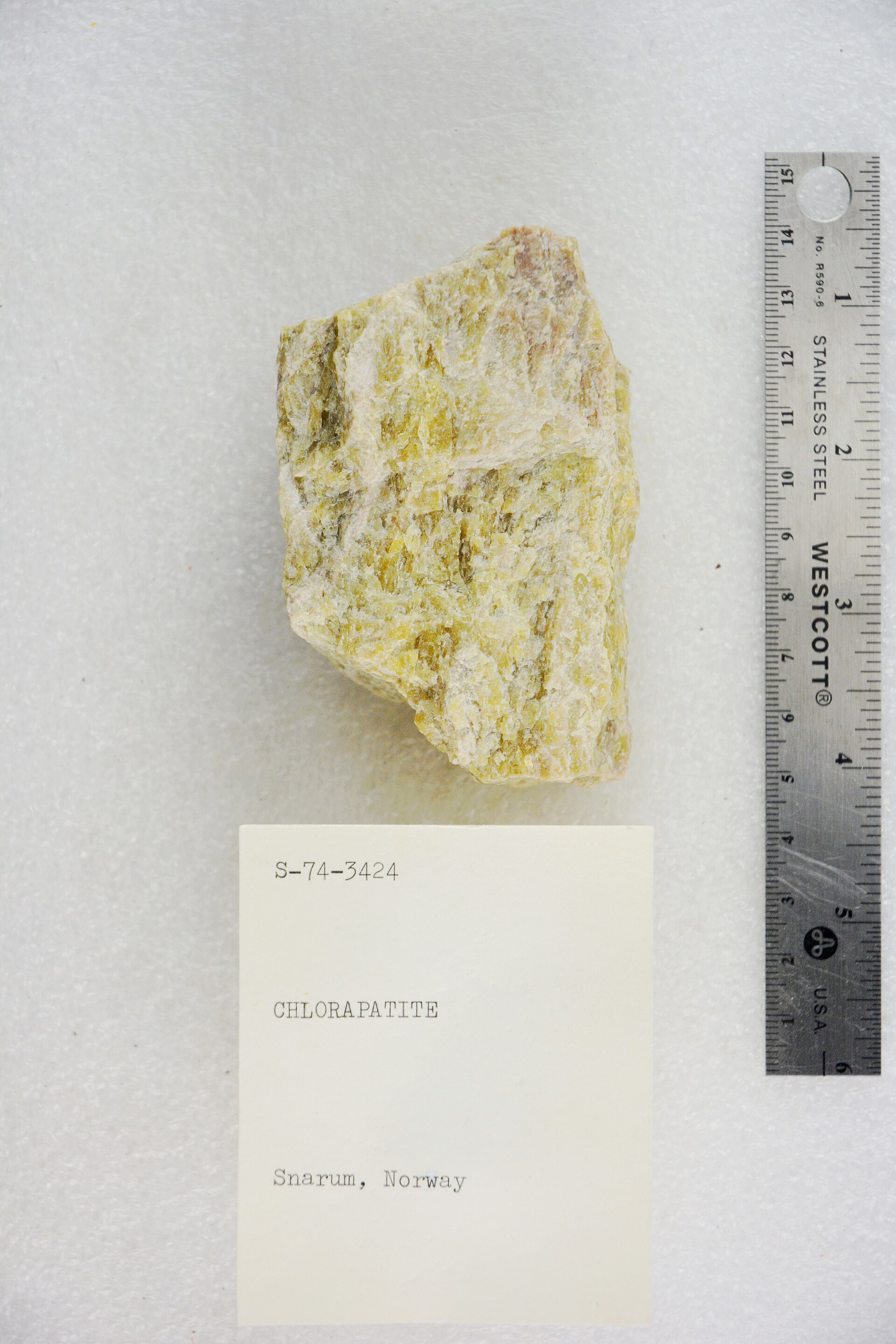
Snarum, Norway — Photo: Pacific Museum of Earth from Canada · CC BY-SA 2.0
Chlorapatite
The chlorine-dominant member of the apatite group — calcium phosphate in which Cl⁻ fills the channel site instead of OH⁻ or F⁻.
Intro adapted from Wikipedia (CC BY-SA).
Chlorapatite is an IMA-recognized mineral species in the phosphate class, with the chemical formula Ca₅(PO₄)₃Cl.
It crystallizes in the hexagonal crystal system (space group P6_3/m). It is a member of the Apatite structural group.
Key properties: Mohs hardness 5; specific gravity 3.17–3.18; typically colorless or white or yellow or gray; white streak; Vitreous luster; optically uniaxial.
IMA symbol Clap, IMA status: approved, named in 1860.
Relatively much rarer than fluorapatite or hydroxylapatite, formed in F-deficient environments. In calcsilicate marble; an accessory mineral in layered mafic intrusions; in veins through diabase; replacing triphylite in granite pegmatite.
It is found associated with Actinolite, diopside, calcite, quartz, talc (Bob’s Lake, Canada); amphibole, chlorite, plagioclase, titanite, datolite (Bull Run quarry, Virginia, USA).
The name refers to dominant chlorine and membership in the apatite group; see fluorapatite.
Collections: Collector Favorites.