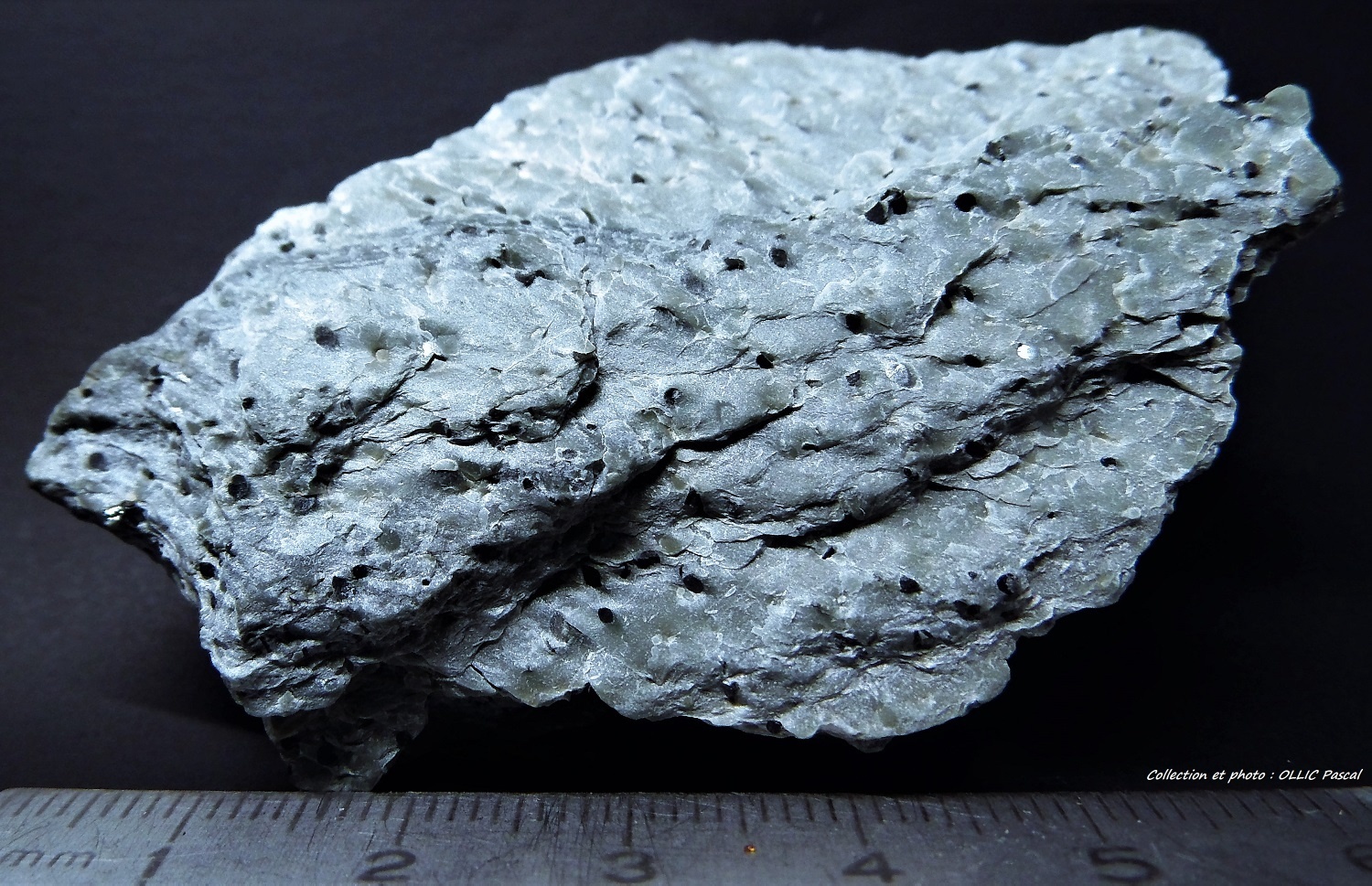
Chloritoid Dimensions: 60 mm × 36 mm × 21 mm Locality: Ottré, Bihain, Vielsalm, Luxembourg, Wallonia, Belgium Description: Greenish black Ottrélite crystals in — Photo: Pascal Ollic · Public domain
Chloritoid
A greenish-gray to black iron-magnesium aluminium silicate forming micaceous plates in medium-grade metamorphic rocks.
Intro adapted from Wikipedia (CC BY-SA).
Chloritoid is an IMA-recognized mineral species in the silicate class, with the chemical formula Fe²⁺Al₂O(SiO₄)(OH)₂.
It crystallizes in the triclinic crystal system (space group C-1). It is a member of the Chloritoid structural group.
Key properties: Mohs hardness 6.5; specific gravity 3.46–3.8; typically green or gray or black; White, grayish, or very slightly greenish streak; Somewhat pearly on cleavage surfaces luster; refractive index 1.727; optically biaxial.
IMA symbol Cld, grandfathered status — known before the IMA’s founding, named in 1832.
Found in regionally metamorphosed pelitic sediments and schists in the biotite, garnet, and lower grade staurolite zones; in quartz-carbonate veins and other hydrothermal environments.
It is found associated with Muscovite, chlorite, staurolite, garnet, kyanite, quartz, mica, rutile.
The name refers to its resemblance to members of the chlorite group.
Collections: Collector Favorites.