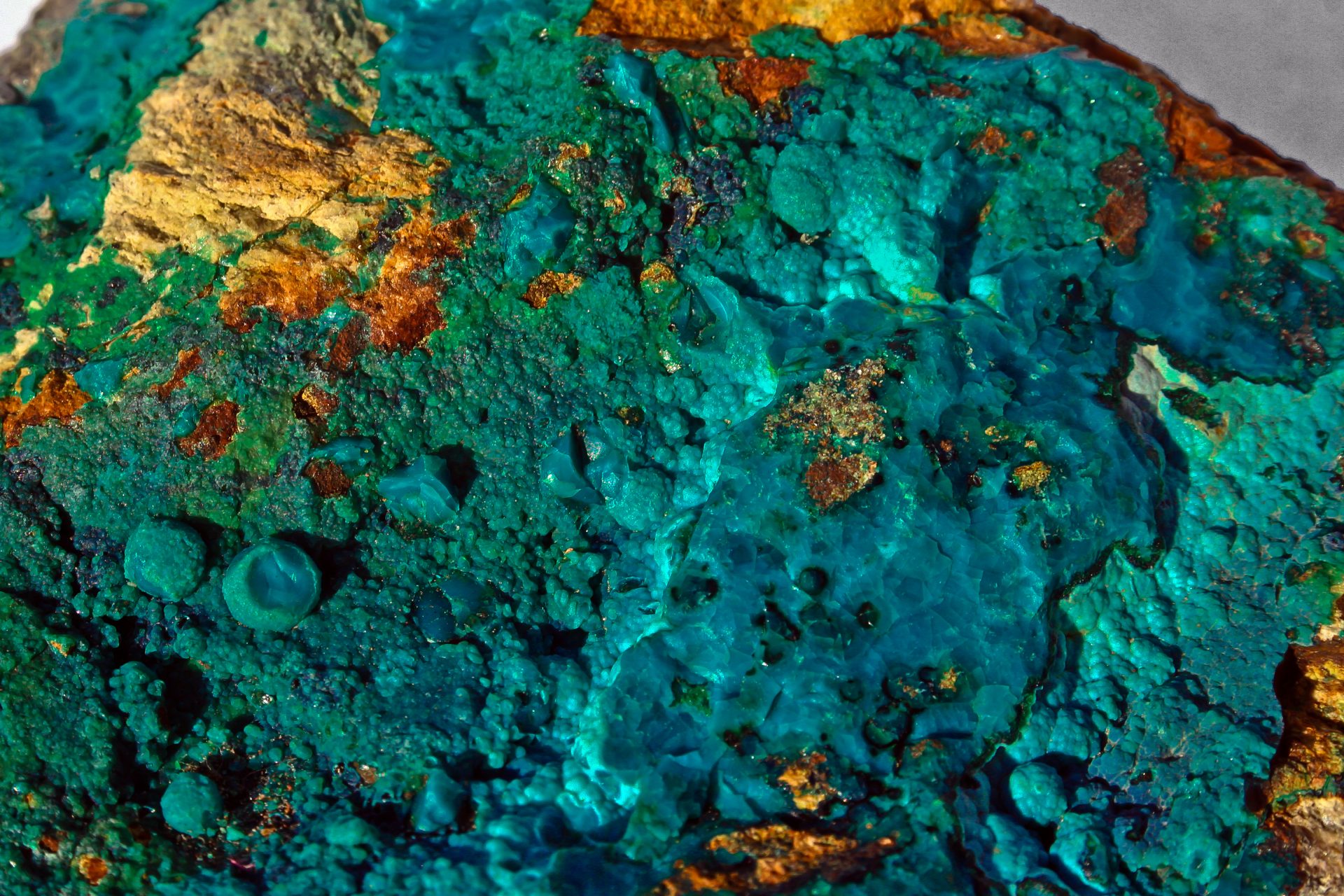
A close-up photograph of a specimen of Chrysocolla from Australia. — Photo: Lloyd.james0615 · CC BY 3.0
Chrysocolla
A blue-green hydrated copper silicate of the oxidized zone — beautiful as a gemstone but possibly a mixture rather than a single mineral.
Intro adapted from Wikipedia (CC BY-SA).
Chrysocolla is an IMA-recognized mineral species in the silicate class, with the chemical formula (Cu₂₋ₓAlₓ)H₂₋ₓSi₂O₅(OH)₄·nH₂O.
It crystallizes in the amorphous crystal system. It is a member of the Allophane structural group.
Key properties: Mohs hardness 2–4; specific gravity 1.93–2.4; White when pure streak; Vitreous, porcelaneous, earthy luster; optically biaxial.
IMA symbol Ccl, IMA status: approved.
Found in the oxidized portions of many copper deposits.
It is found associated with Malachite, tenorite, halloysite, nontronite.
Its name comes from the Greek for gold and glue, for a substance used in the soldering of gold, including chrysocolla as well as other blue and green minerals.