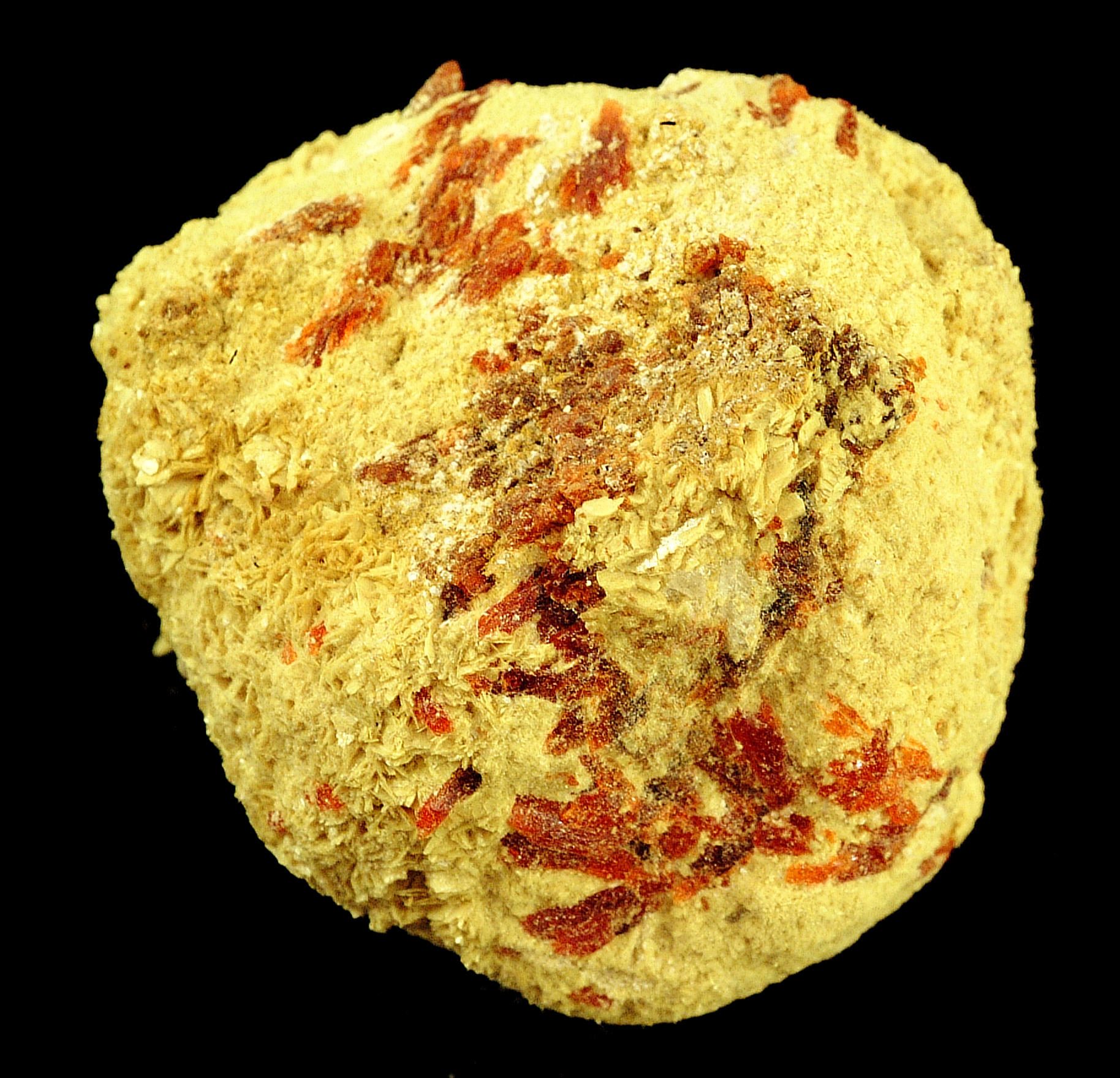
The yellow mineral is copiapite, a secondary mineral that forms from the oxidation of iron sulfide deposits. The red mineral is botryogen, also a secondary mineral. Both are hydrated iron-magnesium sulfate-hydroxides. Copiapite is named for the famous mineral locality at Copiapo, Chile which is where it was first discovered and where this sample comes from. This specimen is 7.5 cm across. — Photo: Twyla Baker · CC0
Copiapite
A hydrated iron sulfate — the classic yellow encrustation formed when pyrite and other sulfides weather; also a mineral group name.
Intro adapted from Wikipedia (CC BY-SA).
Copiapite is an IMA-recognized mineral species in the sulfate class, with the chemical formula Fe²⁺Fe³⁺₄(SO₄)₆(OH)₂·20H₂O.
It crystallizes in the triclinic crystal system (space group P-1). It is a member of the Copiapite structural group.
Key properties: Mohs hardness 2.5–3; specific gravity 2.04–2.17; Pearly on {010} luster; optically biaxial.
IMA symbol Cpi, grandfathered status — known before the IMA’s founding, named in 1833.
A secondary mineral formed typically by the weathering and oxidation of pyrite in a wide range of rock types, preserved in arid climates; rarely in association with fumarolic action.
It is found associated with Melanterite, alunogen, fibroferrite, halotrichite, botryogen, butlerite, amarantite.
The name refers to the city of Copiapó, Chile, near which specimens were first collected.