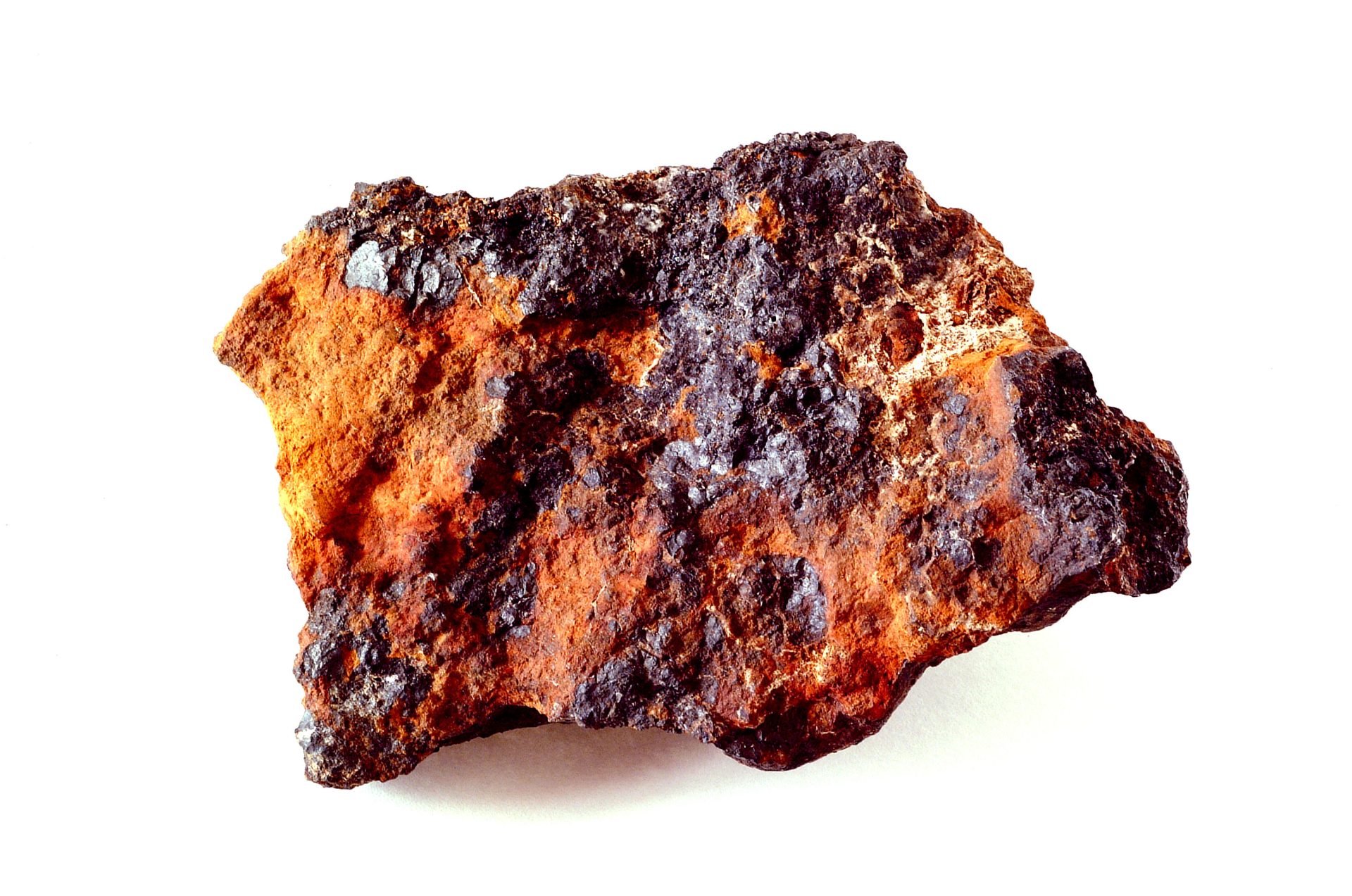
Coronadite is a lead-manganese oxide mineralPbMn8O16 It is found in oxidized portions of manganese deposits. The type locality is in the Coronado Shaft at the Morenci Mine, Greenlee County, Arizona. This specimen is about 7 cm across. — Photo: Shannon Heinle · CC0
Coronadite
Coronadite is the lead endmember of the coronadite group, a family of tectomanganates with a 2 × 2 tunnel structure, isostructural with hollandite. The mineral was first described by Waldemar Lindgren in 1905, from an occurrence in Arizona, and was named after Francisco Vasquez de Coronado, an explorer of south-west US. It is chemically related to ferricoronadite, an Fe+3 analogue, as well as cryptomelane, hollandite, manjiroite and strontiomelane.
Intro adapted from Wikipedia (CC BY-SA).
Coronadite is an IMA-recognized mineral species in the oxides & hydroxide class, with the chemical formula Pb(Mn⁴⁺₆Mn³⁺₂)O₁₆.
It crystallizes in the monoclinic crystal system (space group I2/m). It is a member of the Coronadite structural group.
Key properties: Mohs hardness 4.5–5; specific gravity 5.25–5.5; Brownish black streak; Dull to submetallic luster; optically biaxial.
IMA symbol Cor, grandfathered status — known before the IMA’s founding, named in 1904.
Found as a primary mineral in hydrothermal veins or from hot springs; of secondary origin in oxidized zones above manganese-bearing rocks; also in bedded sedimentary deposits.
It is found associated with Hollandite, pyrolusite, other manganese oxides.
The mineral was named to honor the first Spanish explorer of the American southwest, Francisco Vasquez de Coronado (ca. 1500–1554).