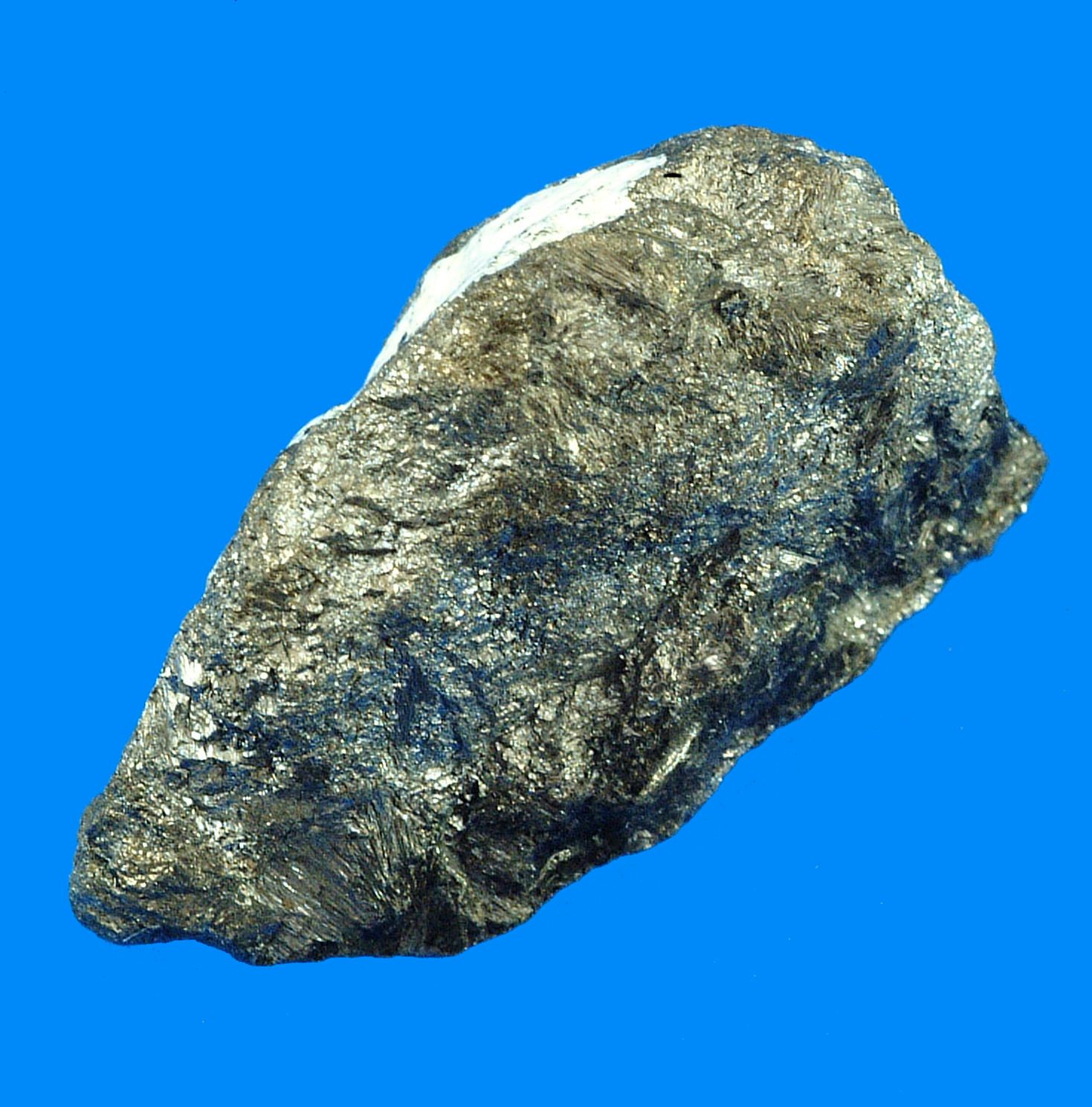
The dark gray material is cosalite, Pb2Bi2S5, a mineral consisting of lead, bismuth, and sulfur. (The white on top is a label.) Cosalite is found in many places, often associated with hydrothermal ore deposits, but generally in very small amounts. This specimen is 3.5 cm long. — Photo: Nessa Eull · CC0
Cosalite
Cosalite is an IMA-recognized mineral species in the sulfosalt class, with the chemical formula Pb₂Bi₂S₅.
It crystallizes in the orthorhombic crystal system (space group Pbnm).
Key properties: Mohs hardness 2.5–3; specific gravity 6.86–6.99; Black streak; Metallic luster.
IMA symbol Cos, grandfathered status — known before the IMA’s founding, named in 1868.
Found in hydrothermal deposits formed at medium temperatures but also found in contact metasomatic replacements, and epithermal replacements, as well as in pegmatites.
It is found associated with Sphalerite, chalcopyrite, pyrite, skutterudite, cobaltite, bornite, enargite, stromeyerite, bismuth, bismuthinite, calcite, tremolite, diopside, epidote, quartz.
The name is derived from the locality at Cosalá, Mexico.