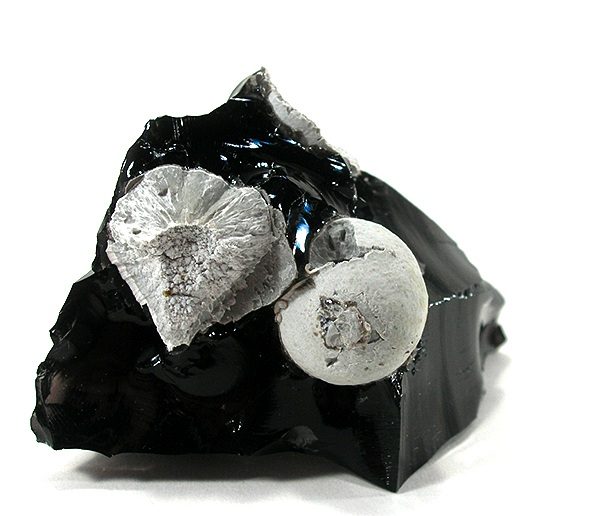
Cristobalite , Fayalite Locality: Canyon Butte occurrence (Couger Butte), Canyon Butte, Siskiyou County , California , USA ( Locality at mindat.org ) Obsidian (volcanic glass) cools too quickly to crystallize. Thus, it is unusual to see minerals attached. The spheres of high temperature cristobalite (SiO2) are actually the result of devitrification, or loss of silica from the obsidian. Most unusual. 5.9 x 3.8 x 3.8 cm — Photo: Robert M. Lavinsky · CC BY-SA 3.0
Cristobalite
A high-temperature polymorph of silica — same chemistry as quartz, different structure — found in volcanic rocks and meteorites.
Intro adapted from Wikipedia (CC BY-SA).
Cristobalite is an IMA-recognized mineral species in the silicate class, with the chemical formula SiO₂.
It crystallizes in the tetragonal crystal system (space group P4_12_12). It is a member of the Cristobalite structural group.
Key properties: Mohs hardness 6–7; specific gravity 2.32–2.36; typically white or colorless; white streak; Vitreous luster; refractive index 1.486; optically uniaxial.
IMA symbol Crs, grandfathered status — known before the IMA’s founding, named in 1887.
Found in vesicles and lithophysae; a late-crystallizing phase in basaltic to rhyolitic volcanic rocks; from acid-sulfate-type hydrothermal alteration of volcanic rocks; precipitated by hot springs. By contact metamorphism of sandstone.
It is found associated with Tridymite, quartz, sanidine, anorthoclase, fayalite, magnetite, kaolinite, alunite, \opal.".
The name refers to the first-noted occurrence at Cerro San Crist¶obal, Mexico.
Collections: Collector Favorites.