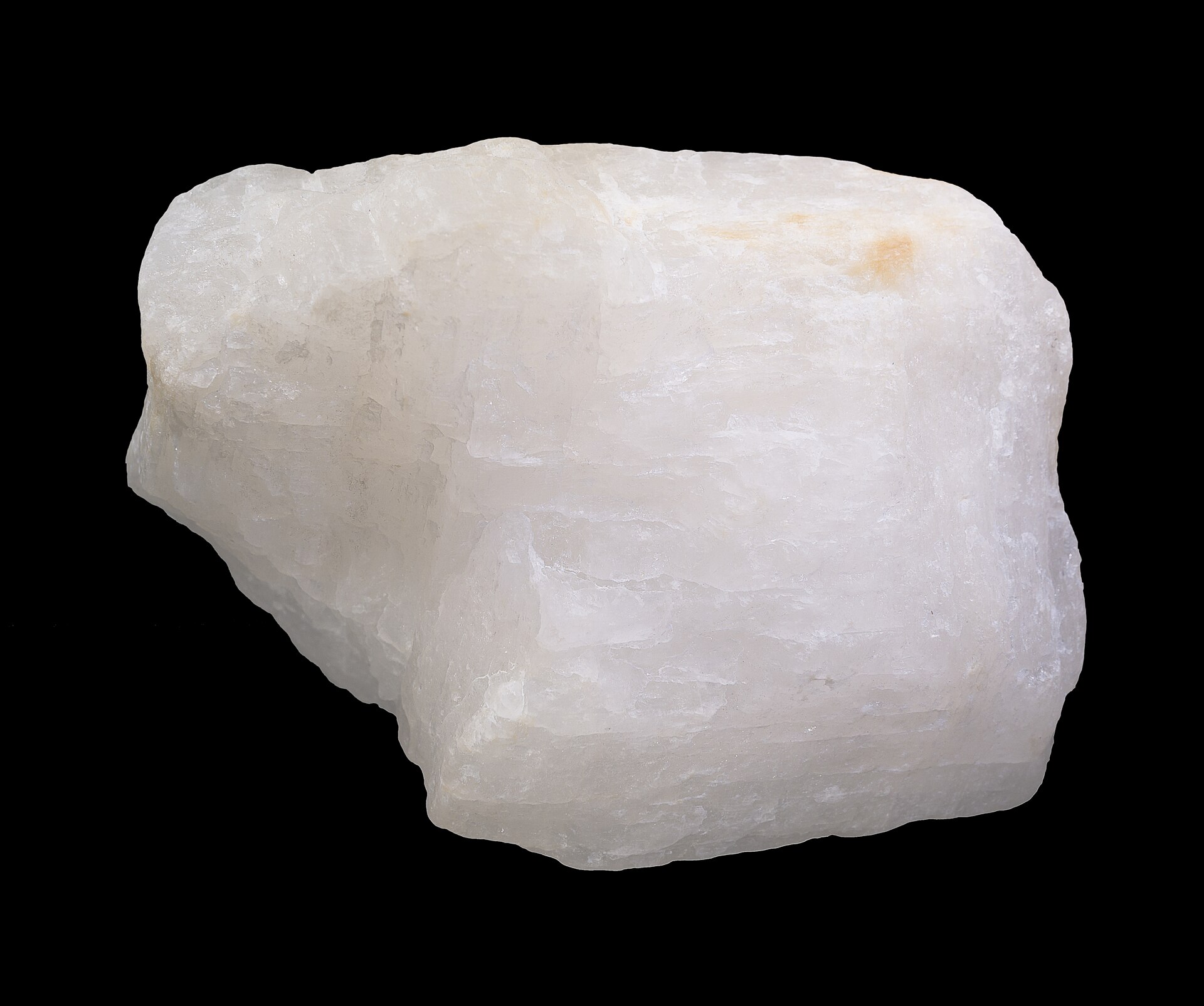
Cryolite – topotype -Former collection of the Faculty of Pharmacy of Paris Locality: Ivigtut Cryolite deposit, Ivittuut (Ivigtut), Arsuk Firth, Arsuk, Kitaa (W — Photo: Didier Descouens · CC BY-SA 3.0
Cryolite
Also known as: Ice stone.
Sodium hexafluoroaluminate — the once-essential flux for aluminium smelting, mined at Ivittuut, Greenland until 1987.
Intro adapted from Wikipedia (CC BY-SA).
Cryolite is an IMA-recognized mineral species in the halide class, with the chemical formula Na₂NaAlF₆.
It crystallizes in the monoclinic crystal system (space group P2_1/n). It is a member of the Perovskite structural group.
Key properties: Mohs hardness 2.5–3; specific gravity 2.97; typically white or colorless or brown or gray or black; White streak; Vitreous to greasy or waxy, pearly on {001} luster; refractive index 1.339; optically biaxial.
IMA symbol Crl, grandfathered status — known before the IMA’s founding, named in 1799.
A late-stage mineral in some granite pegmatites; in tin-bearing alkalic granites; a vapor-phase mineral along fractures and in the groundmass of some fluorine-rich, topaz-bearing rhyolites.
It is found associated with Pachnolite, thomsenolite, gearksutite, cryolithionite, weberite, jarlite, prosopite, chiolite, microcline, quartz, fluorite, siderite, topaz (Ivigtut.
Its name comes from the Greek for ice and stone, alluding to its appearance.
Collections: Collector Favorites, Rare & Remarkable.