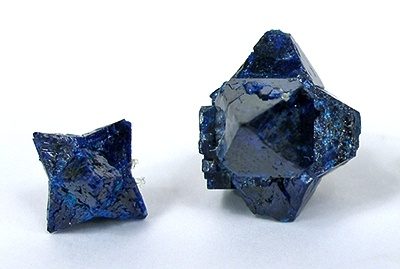
Cumengeite Locality: Amelia Mine, Santa Rosalía (El Boleo) , Boleo District, Municipio de Mulegé , Baja California Sur , Mexico ( Locality at mindat.org ) Size: 1.4 x 1.4 x 1.4 cm (largest). The larger specimen here is 1.4 cm across, and is a classic, sharp, symmetrical cumengeite of high value. The piece dates to older material found at the turn of the 1900s. The smaller specimen next to it is from recent finds (recent meaning in the Larson/Swoboda workings of 1973-1974), and is sharp and fine...but as you can see a bit different in habit from the older material. Either one, in this size, is rare on the market. This specimen from the Dr Miguel Romero collection was on loan exhibition to the University of Arizona Museum for over a decade, until my purchase of this collection in 2008. It was on display in special cases at the museum, and has since been featured in the book "The Miguel Romero Collection of Mexico Minerals" which we sponsored as a special supplement book (published by the Mineralogical Record in December of 2008). — Photo: Robert M. Lavinsky · CC BY-SA 3.0
Cumengeite
A rare blue secondary lead-copper chloride named for mining engineer Édouard Cumenge — easily confused with diaboleite.
Intro adapted from Wikipedia (CC BY-SA).
Cumengeite is an IMA-recognized mineral species in the halide class, with the chemical formula Pb₂₁Cu₂₀Cl₄₂(OH)₄₀·6H₂O.
It crystallizes in the tetragonal crystal system (space group I4/mmm).
Key properties: Mohs hardness 2.5; specific gravity 4.656; Sky-blue streak; Weakly vitreous to adamantine luster; optically uniaxial.
IMA symbol Cge, IMA status: approved, named in 1893.
A secondary mineral formed through reaction of chloride ions with primary sulfides in the oxidized zone of some Pb-Cu deposits; in smelter slag immersed in and leached by sea water. Of exhalative origin near a volcanic fumarole.
It is found associated with Boleite, pseudoboleite, atacamite, anglesite, cerussite, phosgenite, gypsum (Mexico); tenorite, gypsum, cotunnite (Vesuvius).
The name refers to Edouard Cumenge (1828-1902), French mining engineer at Boleo, Mexico, who found the first specimens.