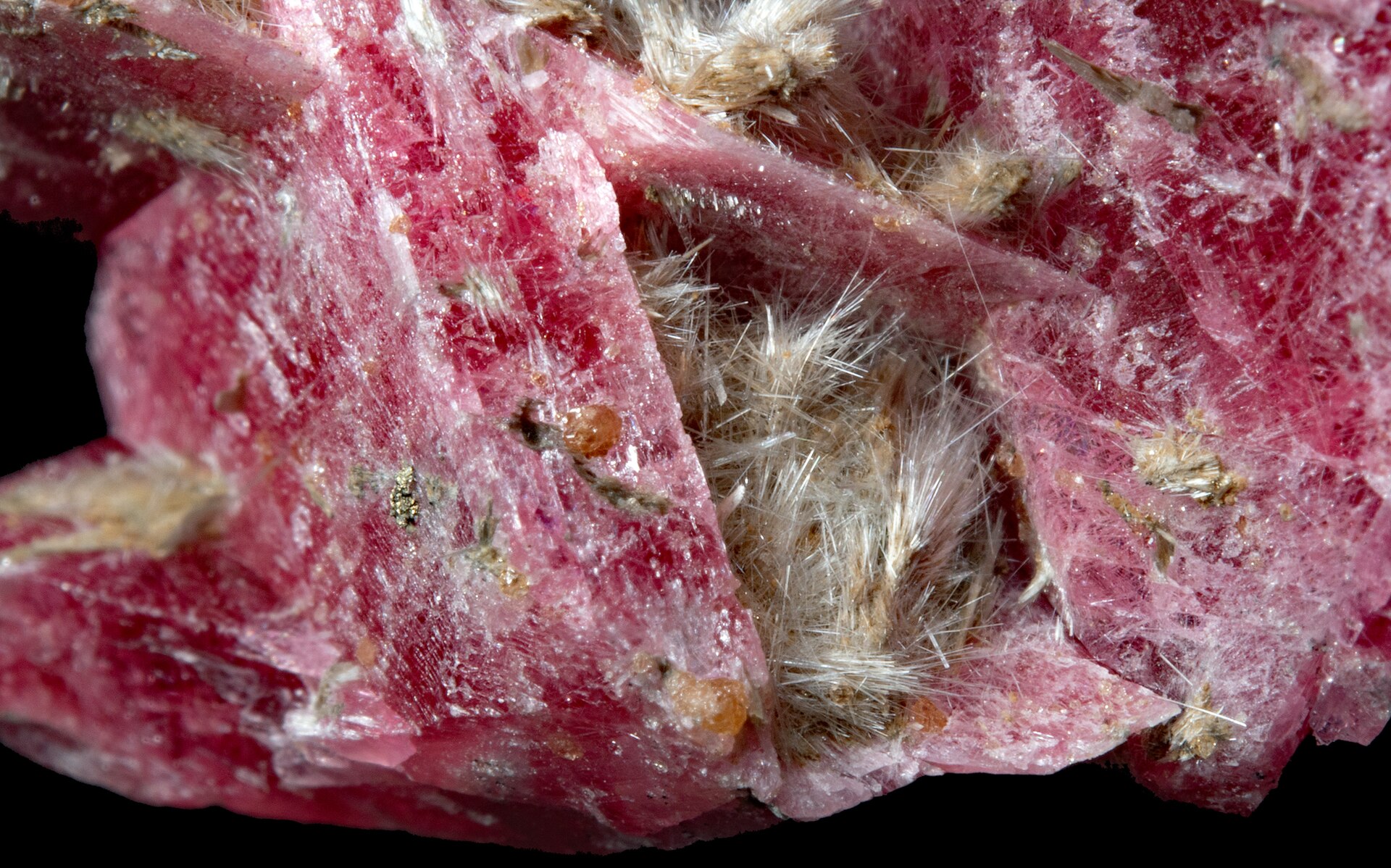
cummingtonite, rhodonite, garnet var. spessartine : Morro da Mina Mine, Conselheiro Lafaiete (Queluz de Minas), Minas Gerais, Brazil - cummingtonite : 7,5 mm — Photo: Géry PARENT · CC BY-SA 4.0
Cummingtonite
A monoclinic magnesium-iron amphibole of metamorphic rocks — the low-symmetry counterpart of anthophyllite.
Intro adapted from Wikipedia (CC BY-SA).
Cummingtonite is an IMA-recognized mineral species in the silicate class, with the chemical formula Mg₂Mg₅Si₈O₂₂(OH)₂.
It crystallizes in the monoclinic crystal system (space group C2/m). It is a member of the Amphibole structural group.
Key properties: Mohs hardness 5–6; specific gravity 3.1–3.6; typically brown or gray; white streak; Vitreous luster; refractive index 1.67; optically biaxial.
IMA symbol Cum, IMA status: approved, named in 1824.
is commonly found in medium-grade regionally metamorphosed rocks; characteristic of metamorphosed iron formations; a late-stage mineral in some gabbros and norites; rarely in silicic volcanic rocks.
It is found associated with \Hornblende, " anthophyllite, actinolite, ferro-actinolite, tremolite, arfvedsonite, magnesio-arfvedsonite, gedrite, glaucophane, quartz, garnet.
The name refers to the occurrence at Cummington, Massachusetts, USA.
Collections: Collector Favorites.