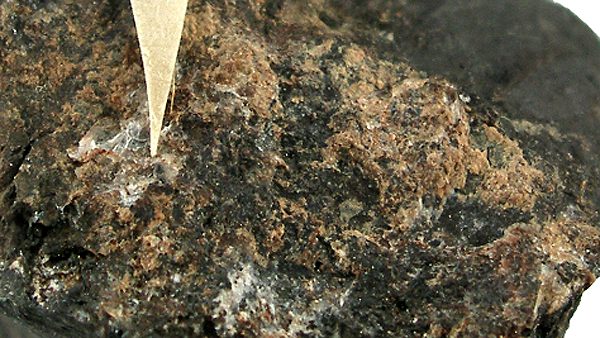
Cymrite Dimensions: 2.2 x 1.6 x 1.6 cm Locality: Benallt Mine (Tyddyn Meirion mine; Ty Canol mine), Rhiw, Llanfaelrhys, Lleyn Peninsula, Gwynedd, Wales, UK Description: A significant and rare micro of this barium aluminum silicate, from the type locality for the species. This specimen is from the American Museum. It was given to them by the British Museum and the AMNH label states on the reverse side: "Part of BM 1944,48" which we take to indicate that this was part of the BM-studied type material (in residence at that time at the BMNH before publication in 1949). From the #1 Orebody. — Photo: Robert M. Lavinsky · CC BY-SA 3.0
Cymrite
A barium aluminosilicate hydrate with perfect cleavage, named for Cymru — the Welsh name for Wales.
Intro adapted from Wikipedia (CC BY-SA).
Cymrite is an IMA-recognized mineral species in the silicate class, with the chemical formula Ba(Si,Al)₄(O,OH)₈·H₂O.
It crystallizes in the monoclinic crystal system (space group P2_1).
Key properties: Mohs hardness 2–3; specific gravity 3.413; Vitreous to satiny luster; refractive index 1.617; optically biaxial.
IMA symbol Cym, grandfathered status — known before the IMA’s founding, named in 1949.
Found in veinlets cutting hydrothermal manganese silicate ore (Benallt mine, Wales); in a copper-bearing deposit in dolostones and siderites (Ruby Creek, Alaska, USA).
It is found associated with Ganophyllite (Benallt mine, Wales); calcite, albite, lawsonite (San Benito Co., California, USA); hyalotekite, banalsite, hyalophane, hedyphane.
The name comes from Cymru, the Welsh name for Wales, the locality of discovery.