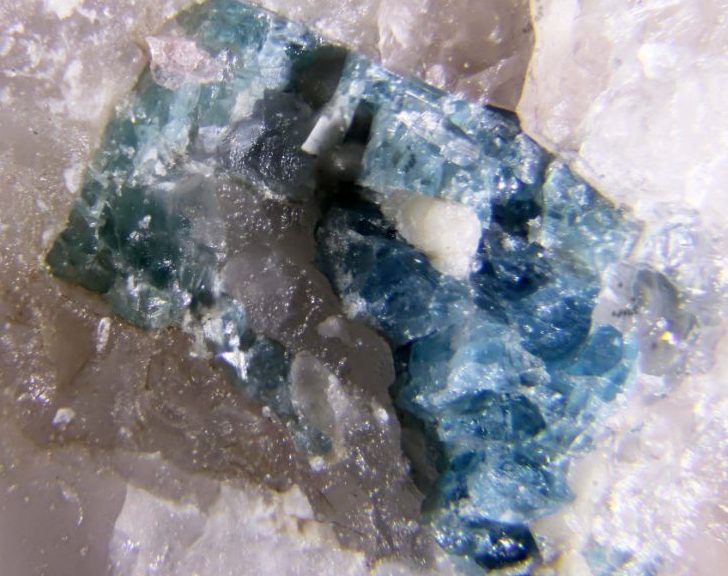
Outstanding blue crystals of this rare member of the vesuvianite group from Norway (Kleppan, Sauland, Hjartdal, Vestfold og Telemark, Norway). Ex Vandenbroucke Museum collection from Waregem, Belgium. — Photo: David Hospital · CC BY-SA 4.0
Cyprine
The copper-dominant member of the vesuvianite group — a complex calcium silicate where Cu²⁺ occupies the key site.
Intro adapted from Wikipedia (CC BY-SA).
Cyprine is an IMA-recognized mineral species in the silicate class, with the chemical formula Ca₁₉Cu²⁺(Al,Mg)₁₂Si₁₈O₆₉(OH)₉.
It crystallizes in the tetragonal crystal system (space group P4/n). It is a member of the Vesuvianite structural group.
Key properties: Mohs hardness 6.5; specific gravity 3.4; Vitreous luster; optically uniaxial.
IMA symbol Cyp, IMA status: approved, named in 2015.
Hydrothermal in origin.
It is found associated with Calcite, apatite, andradite, henritermierite, rhodochrosite.
The name refers to a member of the vesuvianite group with predominance of Cu2+ at the Y1A, B sites. The historical name cyprine (derived from Latin cuprum, copper) given by J.J.