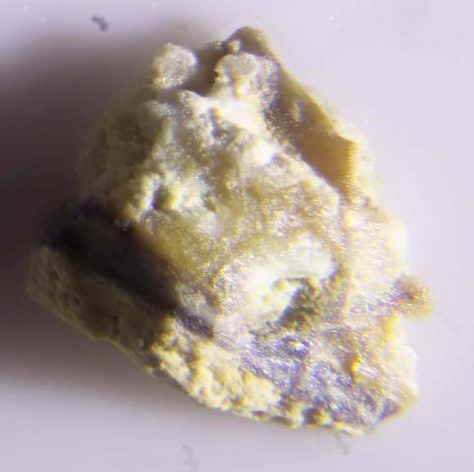
Small yellow specimen of the rare Bi mineral daubreeite from the type locality in Bolivia: Constancia Mine, Cerro Tazna, Nor Chichas Province, Potosi Department, Bolivia. Ex Vandenbroucke Museum collection from Waregem, Belgium. — Photo: David Hospital · CC BY 4.0
Daubréeite
A rare creamy-white bismuth oxychloride occurring as soft, earthy clay-like masses.
Intro adapted from Wikipedia (CC BY-SA).
Daubréeite is an IMA-recognized mineral species in the oxides & hydroxide class, with the chemical formula BiO(OH).
It crystallizes in the tetragonal crystal system (space group P4/nmm). It is a member of the Matlockite structural group.
Key properties: Mohs hardness 2–2.5; specific gravity 6.4–6.5; optically uniaxial.
IMA symbol Dau, grandfathered status — known before the IMA’s founding, named in 1876.
Forms secondarily through alteration of bismuth or bismuthinite, intermixed with “clay” (Tazna, Bolivia).
It is found associated with Kaolinite (?).
The name refers to Gabriel Auguste Daubrée (1814–1896), French mineralogist and geologist.