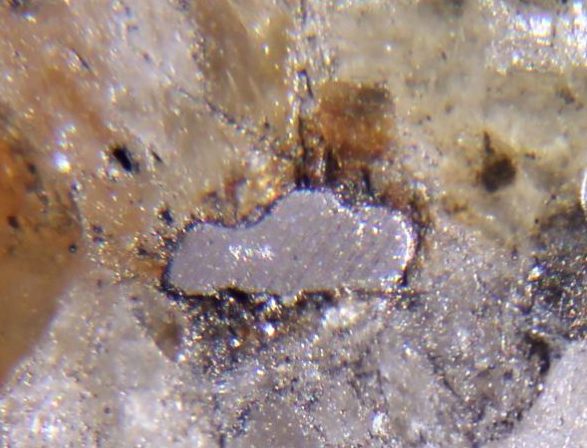
A silvery polished nugget of the very rare Fe-Cr sulphide mineral daubreelite in epoxy resin in an analyzed specimen by SEM/EDS, from Norton County Meteorite (Norton County, Kansas, United States of America). Ex Vandenbroucke Museum collection from Waregem, Belgium. — Photo: David Hospital · CC BY-SA 4.0
Daubréelite
A rare cubic iron-chromium sulfide occurring as black platy aggregates, mostly in meteorites.
Intro adapted from Wikipedia (CC BY-SA).
Daubréelite is an IMA-recognized mineral species in the sulfide class, with the chemical formula FeCr₂S₄.
It crystallizes in the cubic crystal system (space group Fd-3m). It is a member of the Spinel structural group.
Key properties: Mohs hardness 5; specific gravity 3.81; Brown streak; Metallic, brilliant. R: (400) 33.3, (420) 33.2, (440) 33.1, (460) 33.0, (480) 33.1, (500) 33.1, (520) 33.1, (540) 33.0 luster.
IMA symbol Dbr, grandfathered status — known before the IMA’s founding, named in 1876.
Found in small amounts in many meteorites.
It is found associated with Troilite, kamacite, orthoenstatite, plagioclase, alabandite, graphite, schreibersite.
The name refers to Professor Gabriel Auguste Daubrée (1814–1896), of Paris, France, French meteorite researcher.