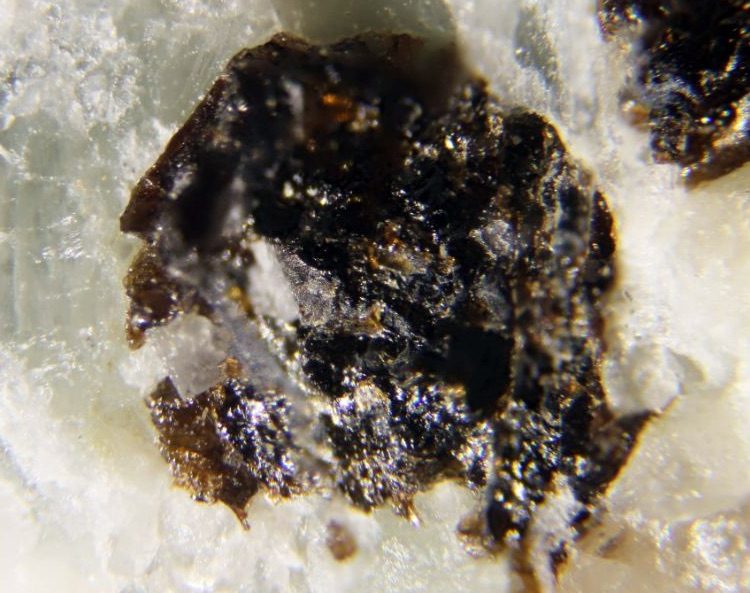
Black crytals of the rare mineral davidite-(Ce) from Arizona (Quijotoa Mountains, Pima County, Arizona, United States of America). Davidite-(Ce) is much rarer than its La analogue Davidite-(La) after Mindat. Unique combination of elements. Ex Vandenbroucke Museum collection from Waregem, Belgium. — Photo: David Hospital · CC BY-SA 4.0
Davidite-(Ce)
Davidite is a rare earth oxide mineral with chemical end members Lanthanum (La) and Cerium (Ce). It exists in two forms: Davidite-(La) (La,Ce,Ca)(Y,U)(Ti,Fe3+)20O38 discovered at Radium Hill mine, South Australia in 1906 and named by Douglas Mawson for Australian geologist Tannatt William Edgeworth David (1858-1934). Davidite-(Ce) (Ce,La)(Y,U)(Ti,Fe3+)20O38 first described in 1960 from Vemork, Iveland Municipality, Norway.
Intro adapted from Wikipedia (CC BY-SA).
Davidite-(Ce) is an IMA-recognized mineral species in the halide class, with the chemical formula Ce(Y,U)Fe₂(Ti,Fe,Cr,V)₁₈(O,OH,F)₃₈.
It crystallizes in the hexagonal crystal system. It is a member of the Crichtonite structural group.
Key properties: Mohs hardness 6; specific gravity 4.29; Black to very dark gray streak; Vitreous luster.
IMA symbol Dvd-Ce, IMA status: approved, named in 1960.
Found in a pegmatite dike, rich in rare-earth minerals, in granite.
It is found associated with Ilmenite, rutile, gadolinite, euxenite, thortveitite, xenotime, allanite, zircon.
The name refers to its relation to davidite and dominant cerium content.