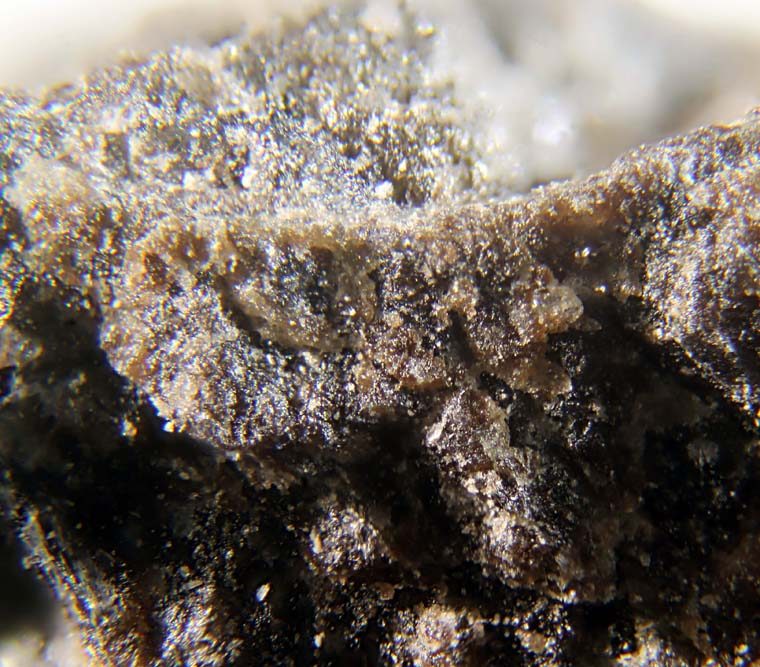
Brown crystal aggregates of dollaseite-(Ce) from the type locality in Sweden (Östanmossa Mine, Norberg, Västmanland County). — Photo: David Hospital · CC BY-SA 4.0
Dollaseite-(Ce)
Dollaseite-(Ce) is a sorosilicate end-member epidote rare-earth mineral which was discovered by Per Geijer (1927) in the Ostanmossa mine (Östanmossa gruva), Norberg district, Sweden. Dollaseite-(Ce), although not very well known, is part of a broad epidote group of minerals which are primarily silicates, the most abundant type of minerals on earth. Dollaseite-(Ce) forms as dark-brown subhedral crystals primarily in Swedish mines. With the ideal chemical formula, CaREE3+Mg2AlSi3O11,(OH)F, dollaseite-(Ce) can be partially identified by its content of the rare earth element cerium.
Intro adapted from Wikipedia (CC BY-SA).
Dollaseite-(Ce) is an IMA-recognized mineral species in the silicate class, with the chemical formula CaCe(Mg₂Al)[Si₂O₇][SiO₄]F(OH).
It crystallizes in the monoclinic crystal system (space group P2_1/m). It is a member of the Epidote, dollaseite structural group.
Key properties: Mohs hardness 6.75; specific gravity 3.9; Vitreous luster; refractive index 1.722; optically biaxial.
IMA symbol Dls-Ce, IMA status: approved, named in 1927.
Found in tactite replacement deposits developed during metamorphism of dolomitic limestone.
It is found associated with Tremolite, norbergite, magnetite, dolomite, calcite.
The mineral was named to honor Professor Wayne A. Dollase, University of California, Los Angeles, California, USA, for his crystal chemical research on minerals of the epidote group.