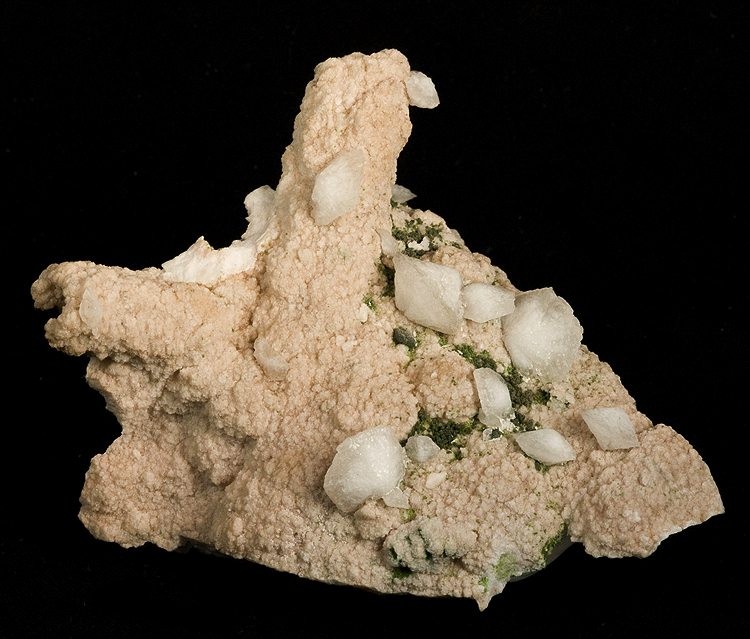
Dolomite (Var.: Zincian Dolomite), Dolomite Locality: Tsumeb Mine (Tsumcorp Mine), Tsumeb, Otjikoto (Oshikoto) Region, Namibia (Locality at mindat.org) Size: 10 — Photo: Robert M. Lavinsky · CC BY-SA 3.0
Dolomite
Also known as: Dolostone (rock), Saddle dolomite.
Calcium-magnesium carbonate — an anhydrous carbonate that gives its name to both a mineral and the rock built from it.
Intro adapted from Wikipedia (CC BY-SA).
Dolomite is an IMA-recognized mineral species in the carbonate class, with the chemical formula CaMg(CO₃)₂.
It crystallizes in the hexagonal crystal system (space group R-3). It is a member of the Calcite-Dolomite structural group.
Key properties: Mohs hardness 3.5–4; specific gravity 2.86; typically white or gray or pink or brown or colorless; White streak; Vitreous to pearly luster; optically uniaxial.
IMA symbol Dol, grandfathered status — known before the IMA’s founding, named in 1792.
Formed by diagenesis or hydrothermal metasomatism of limestone; a primary phase in hypersaline sedimentary environments; a major component of some contact metamorphic rocks and marbles; a gangue in hydrothermal veins.
It is found associated with Fluorite, barite, calcite, siderite, quartz, metal sulfides (hydrothermal); calcite, celestine, gypsum, quartz (sedimentary); talc, serpentine, magnesite.
The mineral was named to honor Dieudonne (Déodat) Sylvain Guy Tancrède de Gratet de Dolomieu (1750–1801), French geologist and naturalist.
Collections: Everyday Minerals, Collector Favorites.