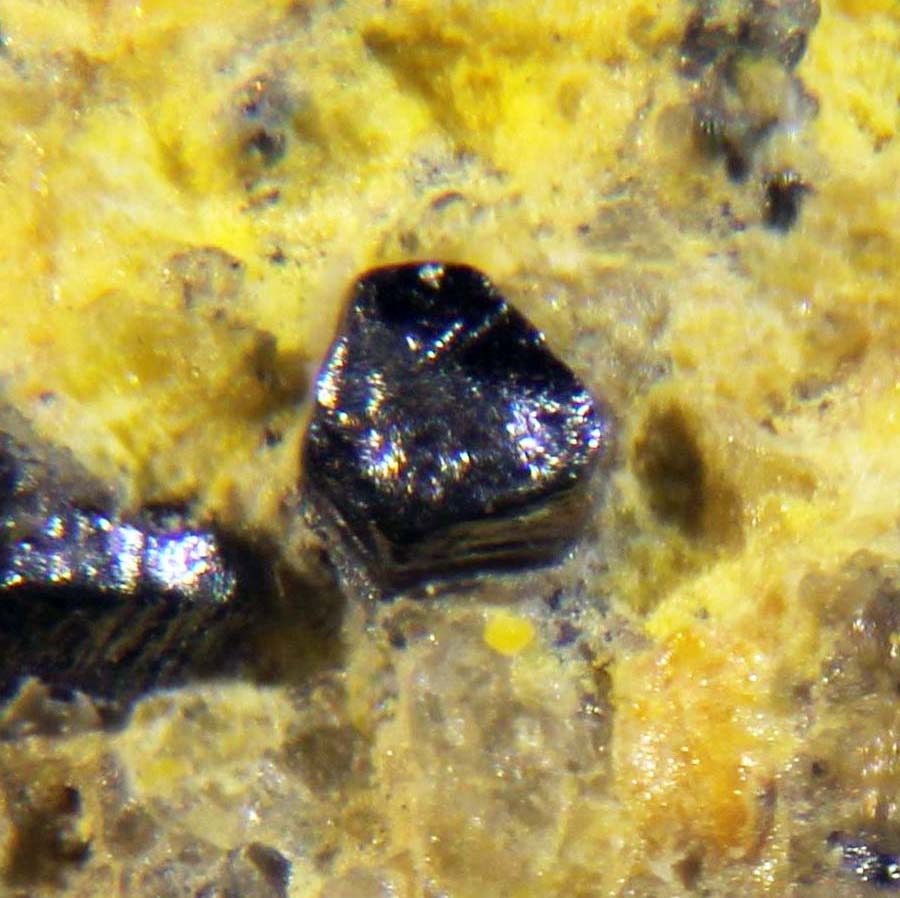
Outstanding metallic hexagonal crystals of the extremely rare Mo-Se mineral drysdallite on a matrix of unidentified uranium minerals from the type locality in Zambia (Kampijimpanga, Solwezi District, North-Western Province, Zambia). Drysdallite is the Se-analogue of molybdenite, but much rarer. Ex Vandenbroucke Museum collection from Waregem, Belgium. — Photo: David Hospital · CC BY-SA 4.0
Drysdallite
A rare molybdenum selenide-sulfide — an opaque, very soft hexagonal mineral.
Intro adapted from Wikipedia (CC BY-SA).
Drysdallite is an IMA-recognized mineral species in the sulfide class, with the chemical formula MoSe₂.
It crystallizes in the hexagonal crystal system (space group P6_3/mmc). It is a member of the Molybdenite structural group.
Key properties: specific gravity 6.248; Brownish black streak; Metallic luster.
IMA symbol Dry, IMA status: approved, named in 1973.
Found in the oxidation zone of a uranium deposit in a talc schist.
It is found associated with Uraninite, apatite, masuyite, secondary uranium minerals.
The mineral was named to honor Dr. A.R. Drysdall (1933–), Director, Geological Survey of Zambia.