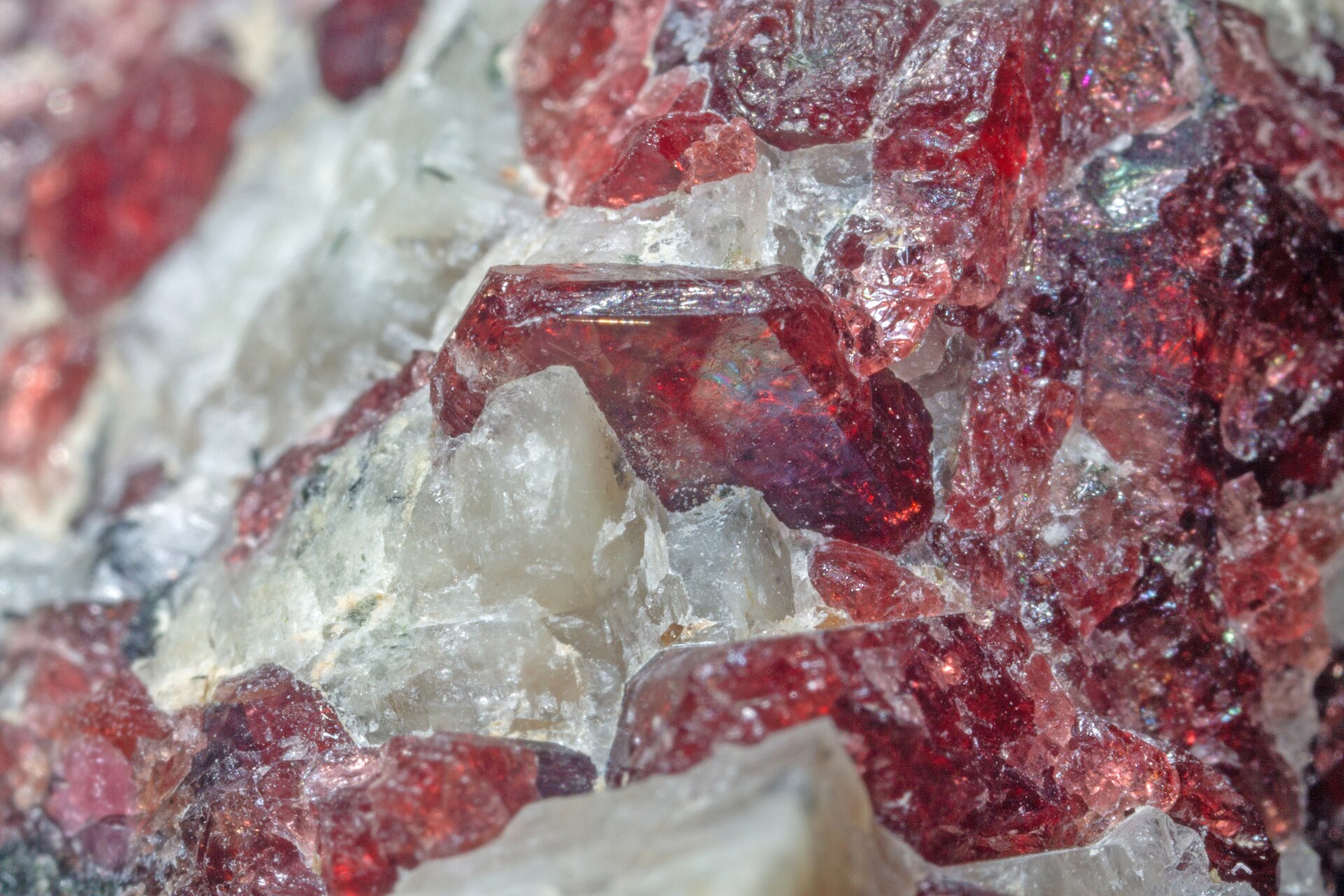
eudialyte, albite : Rasvumchorr Mine, Rasvumchorr Mt., Khibiny Massif, Murmansk Oblast, Russia — Photo: Géry PARENT · CC BY-SA 4.0
Eudialyte
A ring silicate of alkaline igneous rocks whose Greek name means 'easily dissolved' — its red-to-pink crystals are acid-soluble.
Intro adapted from Wikipedia (CC BY-SA).
Eudialyte is an IMA-recognized mineral species in the silicate class, with the chemical formula Na₁₅Ca₆Fe₃Zr₃Si(Si₂₅O₇₃)(O,OH,H₂O)₃(Cl,OH)₂.
It crystallizes in the hexagonal crystal system (space group R-3m). It is a member of the Eudialyte structural group.
Key properties: Mohs hardness 5–6; specific gravity 2.74–3.1; typically red or brown or pink; white streak; Vitreous to dull luster; refractive index 1.61; optically uniaxial.
IMA symbol Eud, IMA status: approved, named in 1819.
Found in nepheline syenites, alkalic granites, and associated pegmatites; may be a major constituent, of both magmatic and late-stage pneumatolytic origin.
It is found associated with Microcline, nepheline, aegirine, lamprophyllite, lorenzenite, murmanite, arfvedsonite, sodalite, aenigmatite, rinkite, lº avenite, titanite, titanian magnetite.
Its name comes from the Greek for easily and dissolved, in allusion to its ready dissolution in acids. All rights reserved. No part of this publication may be reproduced.
Collections: Collector Favorites, Rare & Remarkable.