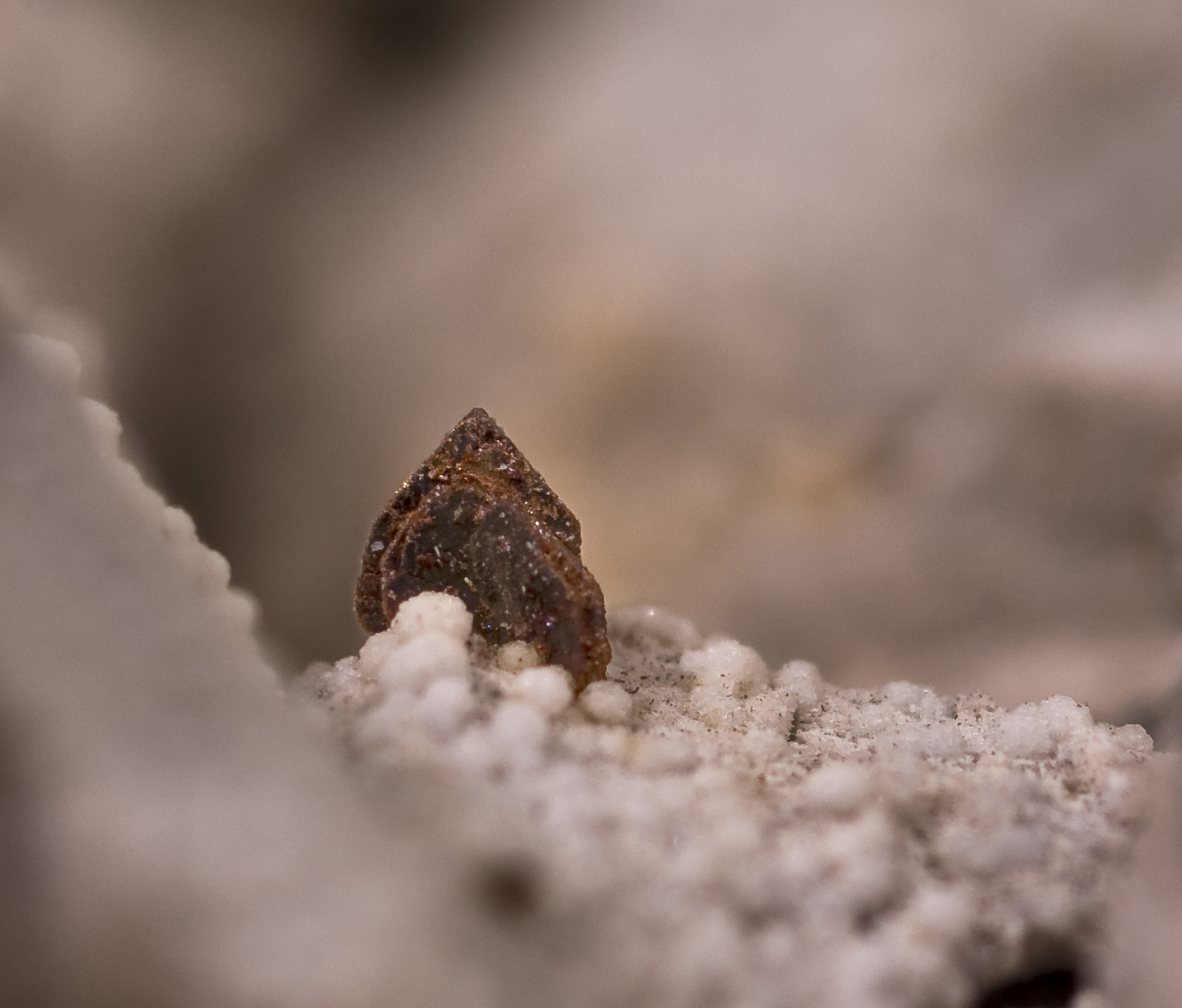
Fayalite with Tridymite balls on Cristobalite. Coso Hot Springs, Coso District (New Coso District), Inyo Co., California, USA - (XX1mm) — Photo: Didier Descouens · CC BY-SA 4.0
Fayalite
Also known as: Iron olivine.
The iron end-member of the olivine series — an orthorhombic iron silicate common in iron-rich rocks and meteorites.
Intro adapted from Wikipedia (CC BY-SA).
Fayalite is an IMA-recognized mineral species in the silicate class, with the chemical formula Fe²⁺₂(SiO₄).
It crystallizes in the orthorhombic crystal system (space group Pbnm). It is a member of the Olivine structural group.
Key properties: Mohs hardness 6.5; specific gravity 4.392; typically brown or yellow or green; White streak; Vitreous to resinous on fractures luster; optically biaxial.
IMA symbol Fa, grandfathered status — known before the IMA’s founding, named in 1840.
Found in ultramafic volcanic and plutonic rocks, less commonly in felsic plutonic rocks; rarely in granite pegmatite; in lithophysae in obsidian. In metamorphosed iron-rich sediments and impure carbonate rocks.
It is found associated with Augite, plagioclase, microcline, quartz, apatite, magnetite, ilmenite, spinel, hedenbergite, arfvedsonite, amphiboles, almandine, tridymite, grunerite.
The name commemorates Faial (Fayal) Island in the Azores, thought to occur in a local volcanic rock, but probably obtained from slag carried as ship's ballast.
Collections: Collector Favorites.