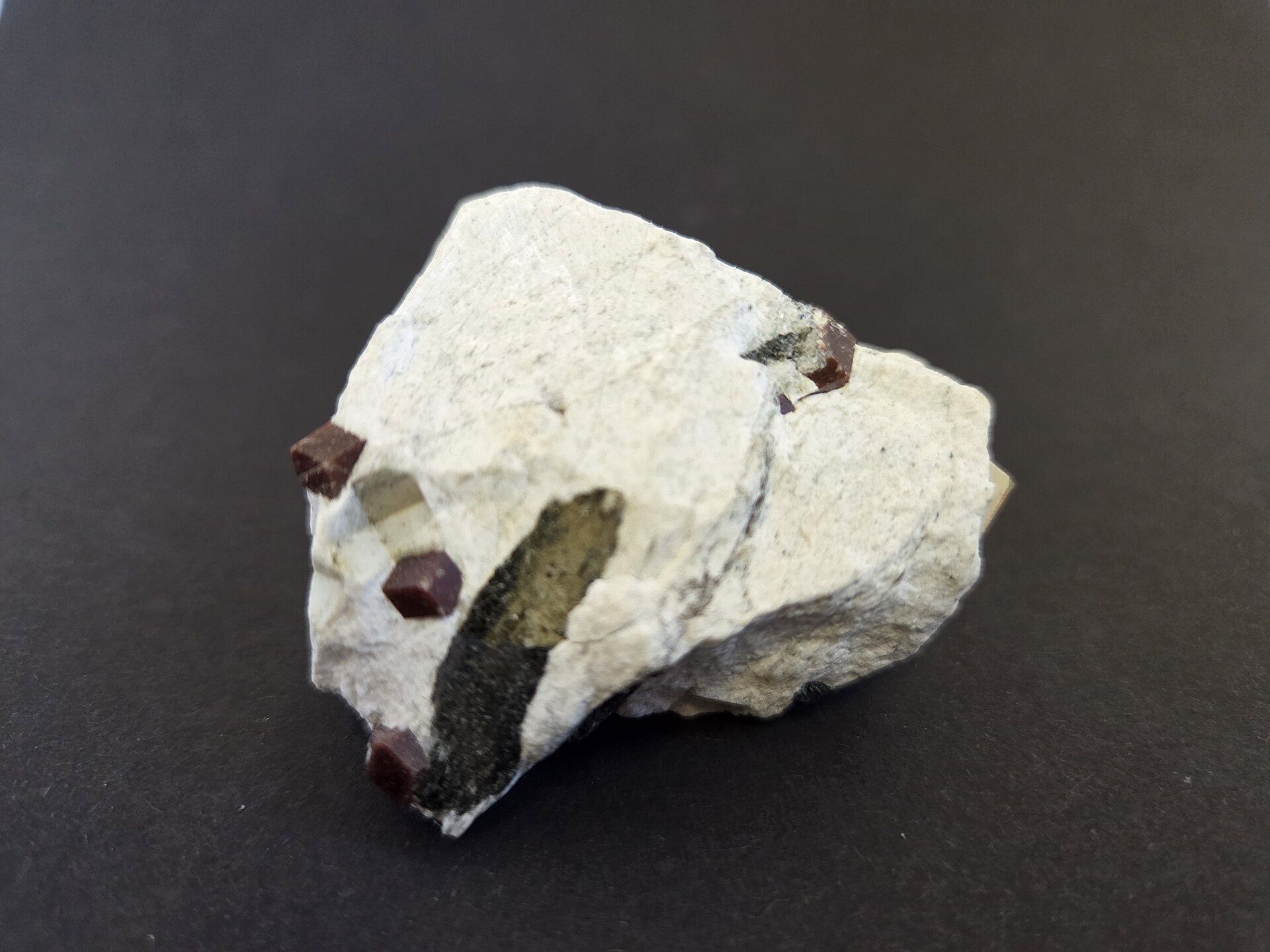
Spessartin Hornblende in Quarz-Keratophyrgestein mit Albit und Quarz — Photo: Strubbl · CC BY-SA 4.0
Ferro-hornblende
Also known as: Hornblende.
The iron-rich member of the hornblende amphibole series — a common dark mineral of igneous and metamorphic rocks.
Intro adapted from Wikipedia (CC BY-SA).
Ferro-hornblende is an IMA-recognized mineral species in the silicate class, with the chemical formula Ca₂(Fe²⁺₄Al)(Si₇Al)O₂₂(OH)₂.
It crystallizes in the monoclinic crystal system (space group C2/m). It is a member of the Amphibole structural group.
Key properties: Mohs hardness 5–6; specific gravity 3.12–3.3; typically black or green; white streak; [Vitreous.] luster; optically biaxial.
IMA symbol Fhbl, IMA status: approved, named in 1978.
From granites, granodiorites, and metabasalts; common in amphibolites and schists. As reaction rims on ferroan hedenbergite.
It is found associated with Hedenbergite (granite); biotite, epidote, albite, quartz (amphibolite).
The name refers to its ferrous iron content and from the German for horn and to deceive, in allusion to its similarity to valuable minerals in ores.
Collections: Everyday Minerals.