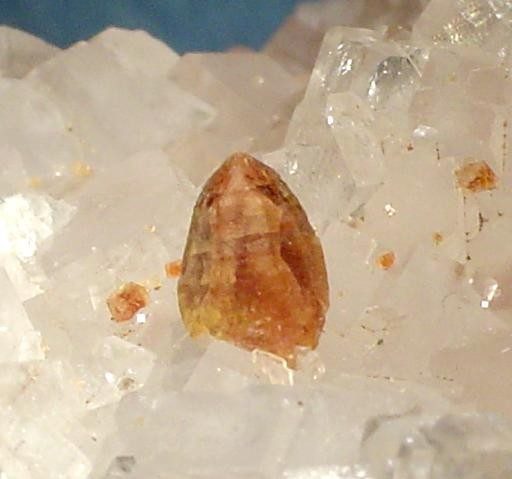
Florencite-(Ce) , Uvite , Magnesite Locality: Serra das Éguas, Brumado (Bom Jesus dos Meiras) , Bahia , Northeast Region, Brazil ( Locality at mindat.org ) Size: 10.5 x 6.7 x 5.2 cm. Florencite-(Ce) is a very rare, rare-earth, cerium-rich phosphate. This fine cabinet combination specimen is covered with very glassy and lustrous, colorless magnesite rhombs to 1.0 cm. The highlight of this specimen, though, is the isolated, 6 mm, sharp, euhedral, straw-yellow florencite-(Ce) crystal on the right side of the piece and the scattered microcrystals. The sprinkling of gemmy, dark cherry-red uvite crystals to 5 mm is a nice bonus. — Photo: Robert M. Lavinsky · CC BY-SA 3.0
Florencite-(Ce)
Florencite-(Ce) is an IMA-recognized mineral species in the phosphate class, with the chemical formula CeAl₃(PO₄)₂(OH)₆.
It crystallizes in the hexagonal crystal system (space group R-3m). It is a member of the Alunite-crandallite structural group.
Key properties: Mohs hardness 5–6; specific gravity 3.45–3.54; Greasy to resinous luster; optically uniaxial.
IMA symbol Flo-Ce, IMA status: approved, named in 1899.
Found as a weathering product, typically of apatite, in highly argillized igneous rocks, bauxite, saprolite, carbonatites; authigenic in shales and sandstones; formed by the interaction of guano-reacted waters with gabbroic rock.
It is found associated with Kaolinite, muscovite, alunite, siderite, quartz (sedimentary rocks); monazite, bastnäsite, apatite, ankerite, strontianite, barite, sphalerite.
The mineral was named to honor Dr. William Florence (1864–1942), Brazilian mineralogist who made an early analysis, and for the dominant rare earth element, cerium.